The EU AI Act and Writers: What Actually Changed on 2 August 2026

On 2 August 2026 the part of the EU AI Act that matters most to writers became applicable: the transparency rules for content made with artificial intelligence. In the weeks before that date, confusion ran in two opposite directions. Some concluded that every novel written with an assistant now needs a label. Others read about the delays agreed in July and decided nothing had changed at all. Neither reading holds up.
This article sets out what took effect, what was postponed, and above all where the line falls between text you must disclose and text you don't. It isn't legal advice and we aren't lawyers: it's a reconstruction from official sources, with links so you can check every point yourself.
What this article covers
What became applicable on 2 August 2026, and what the Digital Omnibus pushed back
When a writer counts as a "deployer" under the law, and when they don't
Why fiction, in almost every case, falls outside the text labelling duty
The cases where the duty does bite, and the exemption that usually cancels it out
What happens when a book cover was generated with AI
Penalties (up to 15 million euros or 3% of turnover) and who enforces them
What became applicable on 2 August 2026?
Since 2 August 2026, Article 50 of the AI Act applies, imposing transparency duties on providers and deployers of certain AI systems, and national market surveillance authorities can enforce it (European Commission, FAQ on transparency obligations under Article 50, retrieved 2026-08-17). These duties are not limited to systems classified as high risk: they apply to any system used in one of the four situations the Article covers.
Only one of those four situations concerns writers directly: publishing text generated or manipulated with AI. The other three cover chatbots (users must know they are talking to a machine), emotion recognition, and deepfake images, audio and video.
The point almost everyone skips: Article 50 does not say "text written with AI must be labelled". It says something far narrower, and the gap between those two formulations decides whether the law touches you at all. We get to it two sections down.
What was postponed, and why it isn't the transparency rules
The delay everyone discussed in July is real, but it lands on a different part of the law. The package known as the Digital Omnibus, formally Regulation (EU) 2026/1744, was published in the Official Journal of the European Union on 24 July 2026 and entered into force on 27 July 2026 (K&L Gates, EU Digital Omnibus on AI Enters Into Force, retrieved 2026-08-17), moving the high risk deadlines back to 2 December 2027 for standalone Annex III systems and to 2 August 2028 for AI embedded in products already regulated under Annex I (Gibson Dunn, EU AI Act Omnibus Agreement, retrieved 2026-08-17).
The transparency duties were not postponed. They have applied since 2 August 2026, along with the enforcement powers of national authorities.
There is one exception, and it's technical. The machine readable marking duty under Article 50(2), which requires providers of systems like the large generative models to make their outputs automatically detectable, was pushed to 2 December 2026 for systems already on the market before 2 August 2026 (European Commission, Article 50 FAQ, retrieved 2026-08-17). That duty sits with the people who build the models, not with the people who write using them.
In practice: if you're a writer, July's delays change nothing for you in either direction. What applies to you has applied since August.
Does a writer count as a "deployer" under the AI Act?
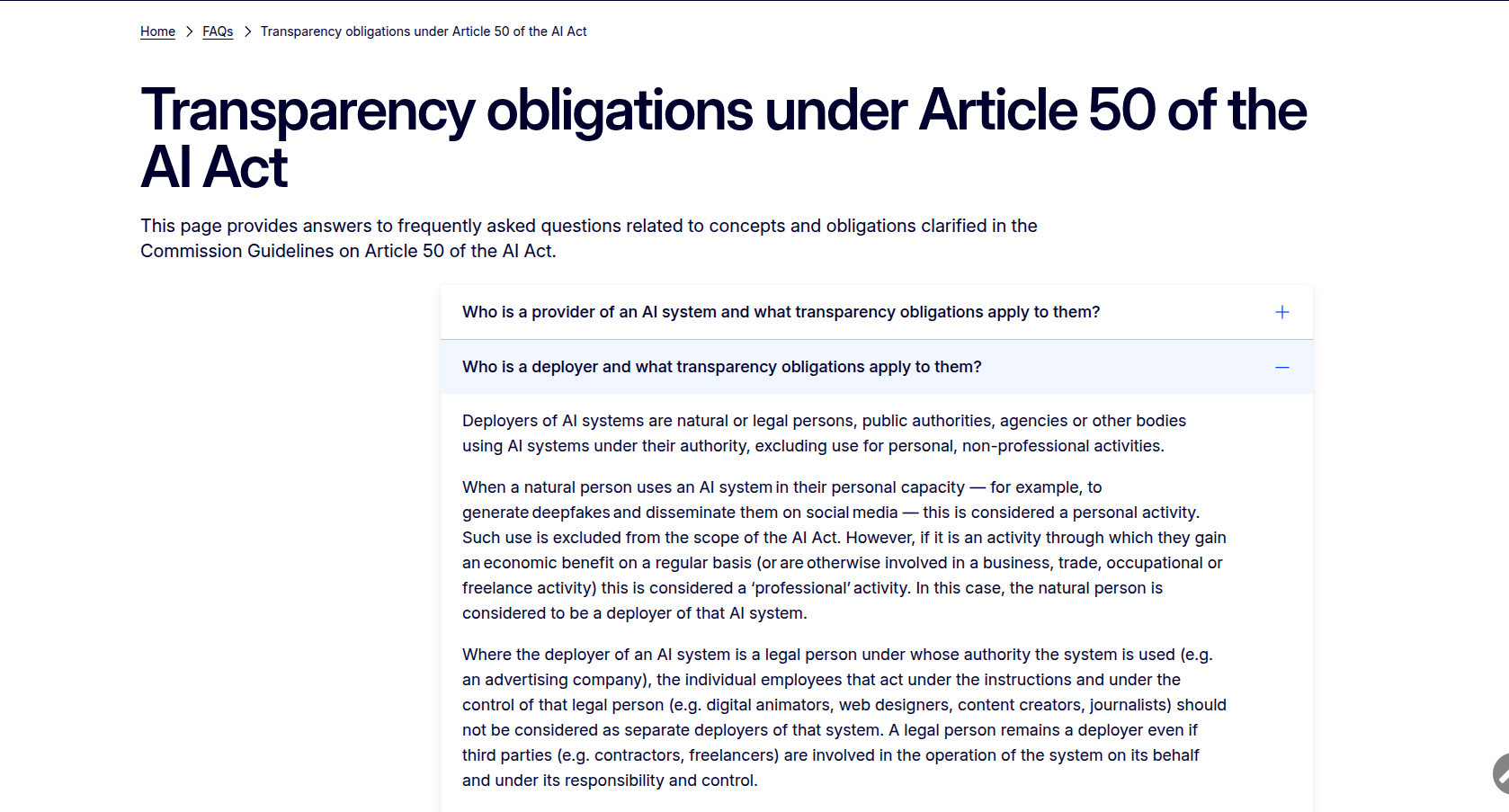
It turns on one thing: whether you write professionally. A person using an AI assistant for personal, non professional purposes falls outside the definition of deployer, while anyone carrying out a business, trade, occupational or freelance activity, or gaining an economic benefit on a regular basis, is squarely inside the obligations (European Commission, Article 50 FAQ, retrieved 2026-08-17).
For writers this reads as follows. The unpublished novel, the journal pages, the short story shared in a writing group stay outside. A book on sale, a blog that earns money, a commissioned article sit inside the professional perimeter, even when the income is small and even without a registered business.
Don't confuse the two roles. A provider develops and supplies the system, and carries technical duties to mark its outputs. A writer is at most a deployer, meaning someone who uses the system, and under Article 50 their duties concern what the reader is told (EU Artificial Intelligence Act, practical guide to Article 50, retrieved 2026-08-17).
One further duty predates all of this and is easy to miss. Article 4 requires anyone using AI systems in the course of professional activity to ensure a sufficient level of AI literacy among those using them on their behalf, and it has applied since 2 February 2025 with no size threshold, so it reaches a sole trader working alone (EU Artificial Intelligence Act, Article 4 on AI literacy, retrieved 2026-08-17). It mandates no courses and no certificates: it asks for measures proportionate to the context. For a writer working solo, that comes down to genuinely knowing what the tool does well and where it fails.
Worth noting: this distinction defuses most of the alarm that circulated among authors. No watermarking duty, no file to certify, no registration with any authority. For an author the whole thing reduces to a single question: do I have to tell the reader, yes or no?
Does a novel written with AI have to be disclosed?
In almost every case, no, and the reason sits in the wording. The labelling duty under Article 50(4) applies to those who publish text generated or manipulated with AI "for the purpose of informing the public on matters of public interest", and the Commission lists areas such as politics, public administration, justice, fundamental rights, public security, health, environment and consumer safety (European Commission, Article 50 FAQ, retrieved 2026-08-17).
A novel doesn't inform the public on matters of public interest. It tells a story. The same goes for a short story collection, a poetry collection, a screenplay. The test isn't the subject matter but the stated purpose of the publication: a thriller set in a hospital doesn't become health information because it features doctors.
That doesn't mean AI assisted fiction carries no consequences. It means the consequences come from elsewhere, not from the EU AI Act: the terms of self publishing platforms, which already ask for a declaration at upload, and copyright rules, which follow an entirely different logic. We covered both here and here.
When does the duty actually bite?
It bites when you publish AI generated text to inform the public on one of those public interest topics. That covers part of practical non fiction, current affairs writing, and blogs dealing with health, environment, rights or politics. A self published guide to nutrition falls inside far more readily than a four hundred page novel.
Then comes the exemption that changes almost everything in practice. The disclosure duty does not apply where the content has undergone human review or editorial control and a natural or legal person holds editorial responsibility for the publication (European Commission, Article 50 FAQ, retrieved 2026-08-17).
The review has to be substantive, though. Commission guidelines define human review as deliberate examination of the substance of the content by one or more people with relevant knowledge, and state plainly that superficial, purely formal or procedural checks, such as spell checking, do not qualify (European Commission, guidelines on transparency obligations, retrieved 2026-08-17).
How this plays out in real work: if you asked an assistant for a draft, rewrote it, checked the facts and put your name on it, you've already met the condition. If you copied the output as it came, skimmed it and published it on a health blog, you haven't. The line doesn't separate people who use AI from people who don't. It separates people who take responsibility for what they publish from people who hand that responsibility to a machine.
What if the cover was generated with AI?

Images follow a different and stricter rule, the one on deepfakes, and here intuition leads you astray. The definition in Article 3(60) covers generated or manipulated content resembling existing persons, objects, places, entities or events that would falsely appear authentic to a viewer (EU Artificial Intelligence Act, Article 3, definition 60, retrieved 2026-08-17).
Everything turns on what "existing" means. The Commission's final guidelines read it broadly: the simulated subject need only resemble someone or something that could exist, or could once have existed, with no identifiable person involved. A photorealistic portrait of an invented person therefore sits inside the deepfake definition, while scenes defying the laws of nature or biology, such as flying humans, dragons or elephants driving cars, fall outside it (Greenberg Traurig, analysis of the Commission guidelines on Article 50, retrieved 2026-08-17).
Translated into book covers: the line doesn't run between real people and invented ones. It runs between plausible photorealism and openly stylised or impossible imagery. An illustrated cover, a drawing, a fantastical scene stay outside. A generated photorealistic face, even of someone who never existed, and a plausible photographic landscape fall inside. That's the opposite of what most authors assume.
Two points from the guidelines that matter in practice: the assessment is intent independent, so the absence of any intention to deceive doesn't remove the duty, and foreseeable exposure to audiences with lower digital literacy has to be taken into account, not just your ideal reader.
Even when the duty applies, the law softens it for evidently artistic work. The exact wording of Article 50(4) of Regulation (EU) 2024/1689 is worth reading, because every word carries weight:
"Where the content forms part of an evidently artistic, creative, satirical, fictional or analogous work or programme, the transparency obligations set out in this paragraph are limited to disclosure of the existence of such generated or manipulated content in an appropriate manner that does not hamper the display or enjoyment of the work."
Note the verb: the obligations are "limited to", not lifted. This is not an exemption, it's a different way of complying. The Code of Practice turns that "appropriate manner" into concrete options: accompanying notes, credits, exhibition materials. For a book it means nobody expects a sticker across the cover, and the copyright page or the credits is the natural place.
Two constraints are easy to lose sight of, though. The first is timing: disclosure must reach the reader at first exposure at the latest, in a clear and distinguishable way, so a note at the front of the book holds up far better than a line at the back. The second is scope: the final guidelines read the categories benefiting from the lighter regime narrowly, and content that is exclusively informative or commercial in nature falls outside them (Stibbe, Deep Fakes, Real Transparency, retrieved 2026-08-17).
The grey area worth knowing: a cover is part of the work, yet it plainly serves a commercial function too, which makes it exactly the kind of hybrid content where the lighter regime can't be taken for granted. If your cover is photorealistic and generated, the cautious choice is to state it in the front matter credits rather than rely on the softening.
What are the penalties, and who enforces them?
Breaching the transparency duties in Article 50 falls under Article 99(4)(g), which provides for administrative fines of up to 15 million euros or, where the offender is an undertaking, up to 3% of total worldwide annual turnover for the preceding financial year, whichever is higher (EU Artificial Intelligence Act, Article 99 on penalties, retrieved 2026-08-17). Paragraph 6 of the same Article flips the test for SMEs, including start ups: whichever is lower.
These are figures built for large platforms, not for an author publishing their own book. Enforcement sits with national market surveillance authorities, acting on complaints or through their own supervisory work, not through automated monitoring of every text published online.
The real picture is patchier than the text of the law suggests, and hardly anyone says so. Article 99 leaves it to Member States to set the penalty regime and notify it to the Commission, with a deadline of 2 August 2025, but national implementation has lagged across the board. The clearest available indicator concerns the designation of authorities: as of March 2026, only eight of the twenty seven Member States had notified single points of contact (European Parliamentary Research Service, Enforcement of the AI Act, retrieved 2026-08-17).
Italy is a documented example of the pattern. Law 132/2025 designated the national cybersecurity agency as market surveillance authority and the digital agency as notifying authority, yet the delegated decrees completing the domestic penalty framework were still not final in early August 2026, with the delegation running to 10 October 2026 (Studio Legale Celotti, AI Act 2 agosto 2026, retrieved 2026-08-17).
Don't draw the wrong conclusion from this. The obligations apply from 2 August 2026 regardless, and authorities keep their corrective and injunctive powers while national penalty frameworks are completed. The delay affects the fining machinery, not whether the rule is in force: anyone who waits will simply have spent the intervening months publishing non compliant content.
There's also a voluntary instrument. The Code of Practice on Transparency of AI-generated Content was finalised on 10 June 2026 and by late July 2026 had around 190 companies and organisations as signatories; the Commission has recognised it as an adequate voluntary tool for demonstrating compliance, and has published a standard icon set for labelling (European Commission, Code of Practice on Transparency of AI-generated Content, retrieved 2026-08-17).
Does this apply if you publish from outside the EU?
Yes, when your work is aimed at readers in the European Union. The AI Act follows the market rather than the author's residence, the same logic anyone who dealt with the GDPR already knows. An author in the United States, Canada or Australia selling an ebook to European readers is inside the scope, and so is a blog with a meaningful European audience.
In practice this matters most for non fiction. If you publish English language guidance on health, finance or the environment and your readers include Europeans, the question of whether you reviewed and stand behind that text is a live one, regardless of where you sit.
What to do now, concretely
For writers, the list is short:
Work out whether your writing is professional. If you sell your work or earn regularly from it, you're a deployer. If you write for yourself, you're not.
Separate fiction from public interest writing. The first is almost always outside the text labelling duty, the second needs a topic by topic judgement.
Make the review real. If you publish text on public interest topics that started as a generated draft, check the facts and rewrite. That's the exemption the law provides, and it's worth documenting internally.
Check images, not just text. For a book the delicate case is photorealism as such, including invented people and places. An illustrated or stylised cover stays outside.
Watch 2 December 2026. That's when the extension on automatic output marking runs out. From then on generated content becomes automatically detectable by the systems that scan it, which shifts the practical context even for people with no direct duties.
Don't confuse the AI Act with platform rules. The declarations required when you upload a book predate all of this and remain in force regardless: they answer commercial policy, not European law.
Frequently asked questions
Do I need a note on my novel if I used AI to edit the text?
No, for two independent reasons. First, the Article 50(4) duty covers text published to inform the public on matters of public interest, and a novel doesn't fall into that category. Second, the rule speaks of text generated "or manipulated", and a minor technical intervention such as spell checking doesn't meet that threshold. Don't stretch the reasoning too far, though: a substantive rewrite handed to the model is a different matter, and on public interest text it would need assessing.
Does the AI Act apply if I publish from outside Europe but sell in Europe?
Yes. Article 2(1)(c) extends the regulation to providers and deployers established in a third country where the output produced by the AI system is used in the Union (EU Artificial Intelligence Act, Article 2 on scope, retrieved 2026-08-17). What counts is where the output lands, not where the writer sits.
If I run a free blog with no income, am I covered?
Probably not. Someone using an AI system in the course of a personal, non professional activity falls outside the deployer definition. One detail people miss: what matters is the activity, not the price. A blog with no subscriptions and no ads, but which promotes your professional practice, still sits inside the perimeter.
What changes on 2 December 2026?
The extension granted to providers of generative systems already on the market for machine readable marking under Article 50(2) expires. It concerns model developers rather than users, but from that date generated text becomes easier to detect automatically.
Does my publisher take on editorial responsibility for me?
Where there's a substantive review process and someone answering for the publication, the exemption in the law operates. That's exactly how traditional publishing works. Anyone self publishing holds both roles, so editorial responsibility is their own.
Does editorial review cover generated images too?
No, and this is the sharpest trap in Article 50. The human review and editorial responsibility exemption sits in the subparagraph on public interest text: there is no equivalent clause for deepfakes (Kulturigo, analysis of the Article 50 labelling duty, retrieved 2026-08-17). You can review and sign an article as thoroughly as you like: if the cover is a generated photorealistic image, it still has to be disclosed, albeit in the lighter form allowed for artistic works.
In short
2 August 2026 changed less than feared for people writing fiction, and more than most realise for people publishing guidance on sensitive topics. For text, the dividing line isn't between writers who use AI and writers who don't. It's between text that informs the public and text that tells a story, and then, within the first group, between people who genuinely review and sign what they publish and people who simply forward an output.
Two things, though, apply to everyone, novelists included. Images follow their own rule: if a photorealistic cover is generated or manipulated, editorial review exempts nothing, and the disclosure still has to be made, even in the lighter form allowed for artistic works. And Article 4 on AI literacy has bound anyone using these tools in a professional capacity since 2 February 2025, whatever genre they write.
The next date to mark is 2 December 2026. For writers it brings no new direct duties, but it shifts the ground: the extension on machine-readable marking runs out, so output from systems already on the market becomes detectable by the machines that scan it, and transparency offered voluntarily will count for more than it does today.
For more on where artificial intelligence meets publishing, see here and here.
SOURCES
All sources consulted and verified on 2026-08-17.
European Commission, Transparency obligations under Article 50 of the AI Act (official FAQ), https://digital-strategy.ec.europa.eu/en/faqs/transparency-obligations-under-article-50-ai-act
European Commission, Guidelines on transparency obligations for providers and deployers of AI systems, https://digital-strategy.ec.europa.eu/en/library/guidelines-transparency-obligations-providers-and-deployers-ai-systems
European Commission, Code of Practice on Transparency of AI-generated Content, https://digital-strategy.ec.europa.eu/en/policies/code-practice-ai-generated-content
EU Artificial Intelligence Act, The EU AI Act's Transparency Rules: A Practical Guide to Article 50, https://artificialintelligenceact.eu/transparency-rules-article-50/
EU Artificial Intelligence Act, Article 2: Scope, https://artificialintelligenceact.eu/article/2/
Kulturigo, KI-Kennzeichnungspflicht seit August 2026: warum redaktionelle Kontrolle nur bei Texten befreit, https://www.kulturigo.de/ki-kennzeichnungspflicht-seit-august-2026-wen-artikel-50-der-ki-verordnung-trifft-und-warum-redaktionelle-kontrolle-nur-bei-texten-befreit-2265767.html
EU Artificial Intelligence Act, Article 3: Definitions (definizione 60, deepfake), https://artificialintelligenceact.eu/article/3/
European Parliamentary Research Service (EPRS), Enforcement of the AI Act, https://epthinktank.eu/2026/03/18/enforcement-of-the-ai-act/
Studio Legale Celotti, AI Act 2 agosto 2026: cosa è vero e cosa no, https://www.studiolegale.celotti.net/ai-act-2-agosto-2026-cosa-e-vero-cosa-no/
Stibbe, Deep Fakes, Real Transparency: Labelling Deep Fakes and AI-Generated Public-Interest Text, https://www.stibbe.com/publications-and-insights/deep-fakes-real-transparency-labelling-deep-fakes-and-ai-generated-public
Greenberg Traurig, Deepfakes, Chatbots, AI-Generated Text: European Commission Details Transparency Obligations Under the AI Act, https://www.gtlaw.com/en/insights/2026/6/deepfakes-chatbots-ai-generated-text-european-commission-details-transparency-obligations-under-the-ai-act
EU Artificial Intelligence Act, Article 4: AI Literacy, https://artificialintelligenceact.eu/article/4/
EU Artificial Intelligence Act, Article 99: Penalties, https://artificialintelligenceact.eu/article/99/
Gibson Dunn, EU AI Act Omnibus Agreement: Postponed High-Risk Deadlines and Other Key Changes, https://www.gibsondunn.com/eu-ai-act-omnibus-agreement-postponed-high-risk-deadlines-and-other-key-changes/
K&L Gates, EU Digital Omnibus on AI Enters Into Force, https://www.klgates.com/EU-Digital-Omnibus-on-AI-Enters-Into-Force-7-31-2026
Important note. We aren't lawyers. What you've read here is our own reading of the sources listed above, all linked precisely so you can check them one by one. In several places it is an interpretation: the rules are recent, the Commission's guidelines leave room for judgement, and on some borderline cases there is as yet no settled practice and no decision that anyone can point to. This article is therefore for information only and is not legal advice. For any decision touching your own situation, particularly non fiction on health, legal, or environmental topics, talk to your own lawyer, ideally one who specialises in digital law.
Pronto a scrivere il tuo prossimo capolavoro?
15 giorni gratis, nessuna carta richiesta.