How to Organize Characters in a Long Novel Without Losing Track
In chapter 3, a character's eyes are green. By chapter 20, they've turned brown, and nobody noticed until the edit. That's not a mistake careless writers make: it's what happens to almost anyone writing a novel long enough to outpace what memory alone can hold. This article explains how to avoid it, with a concrete method, not a generic "just take notes."
What you'll find in this article
Why memory stops being enough past a certain number of characters, and at what point in a novel the problem actually starts
What a character sheet needs to include to be useful, not just filled out
How to keep a consistent timeline without a separate document to update by hand
How to map character relationships once your cast grows
The 4 most common continuity errors, and a practical way to catch them before the edit
Why is it so easy to lose track of your characters?
It's not a talent problem, it's a volume problem. A quiet, character-driven novel can run on 2 to 5 secondary characters; a sprawling saga or epic fantasy can normally reach 20 to 30 without that being unusual for the genre (Fantasy-Writers.org, guide on how many characters, accessed 2026-08-03). Past that point, holding it all in your head without writing any of it down becomes arithmetically impossible, not a question of effort.
The extreme case, just to put the scale of the problem in perspective: Robert Jordan's The Wheel of Time saga has 2,787 distinctly named characters, according to Wikipedia's official list (List of The Wheel of Time characters, accessed 2026-08-03). Nobody writes a cast that size by accident: there's always a tracking system behind it, not just the author's memory.
A practical signal: if you've already searched your manuscript with Ctrl+F for "what was that chapter 8 side character's name again," the problem has already started. You don't need to wait for it to get worse.
What should a useful character sheet include?
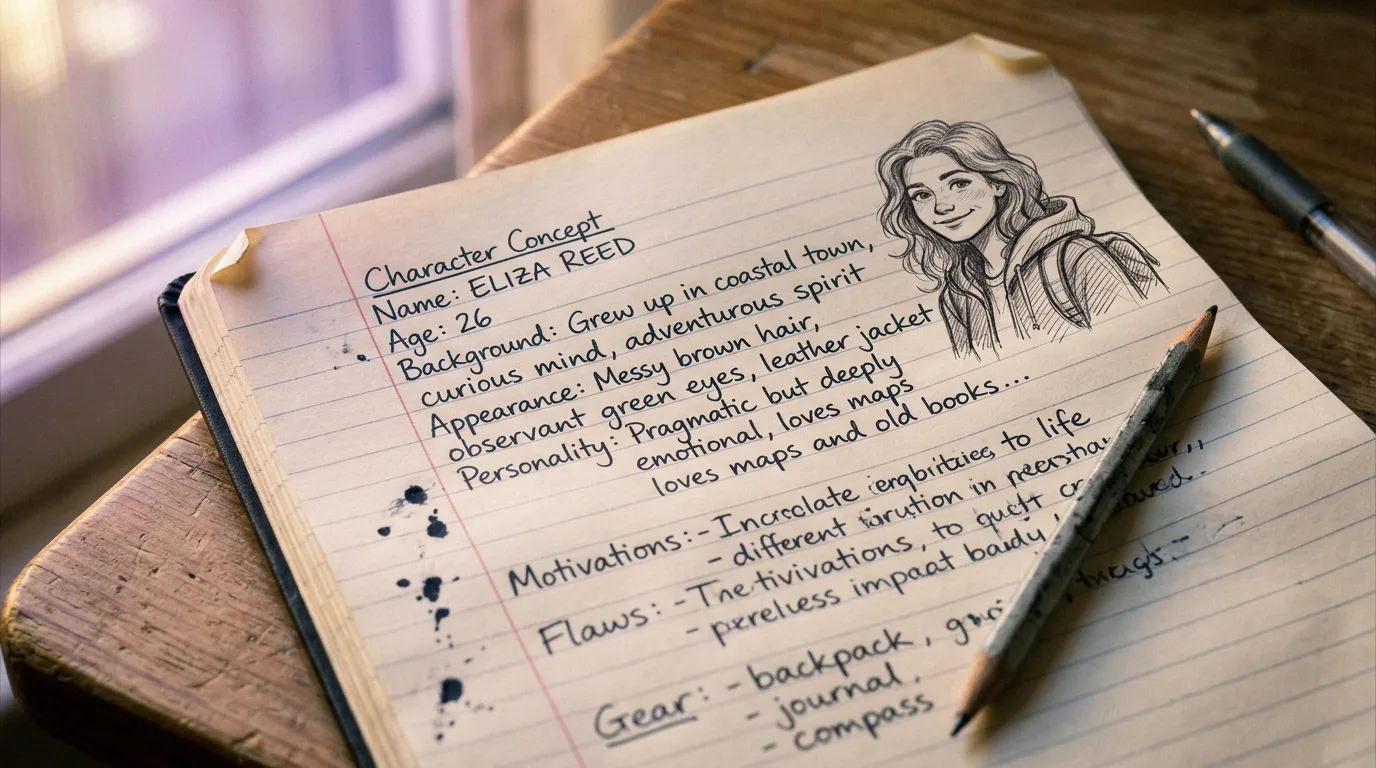
A useful character sheet answers questions you'll actually ask yourself while writing, not just biographical trivia. The most common mistake is filling out an exhaustive sheet at the start and never touching it again, while the character in the story keeps changing. The fields that actually matter fall into four groups:
Identity: name, nickname, age, occupation. The first things a reader notices, and where a mistake becomes visible immediately.
Physical appearance: height, build, hair, eyes. Exactly the category where the chapter-3-versus-chapter-20 mistake is born.
Psychology: motivations, fears, flaws, secrets. Less visible to a distracted reader, but it's what holds a character's choices together across the whole plot.
Story arc: where they start, where they end up, what they want at each stage of the story. Without this field, the sheet describes a static person, not a character who moves through the story.
Anyone who writes long novels learns this fast: a character sheet only earns its keep if it's one click away from wherever you're writing. A separate document open in another window gets checked the first few times, then less and less, until it drops out of the habit in exactly the chapters where it would matter most.
How do you keep a consistent timeline without a separate document?
The most common approach, a separate file listing the timeline of events, tends to fail for the same reason every time: it has to be updated by hand whenever the plot changes, and sooner or later someone forgets. It's the same underlying limit we described when talking about where Word and Google Docs start to feel tight on a long novel: a single document can carry the text, but not a second layer of information tied to specific points in the plot. The solution that actually works is different: link timeline events directly to the chapters where they happen, so the timeline updates itself as the novel takes shape, instead of being a parallel copy you have to keep in sync.
A typical timeline mistake: a character dies in chapter 15 and then shows up alive in a flashback written in chapter 22, without it being marked as a flashback. That's not a plot mistake, it's a tracking mistake: the date of the event wasn't visible anywhere while that scene was being written.
Do this now: before writing a scene with multiple characters involved in an event, check in a single place, not from memory, who's alive, who knows what, and where each of them is at that point in the story.
How do you map character relationships as your cast grows?

Relationships are the hardest thing to keep in a text-based sheet, because they're not a property of a single character: they always involve at least two people, and they change over time. A mother and a son, two rivals who become allies, a mentor who betrays their student: writing all of that into a bulleted sheet forces you to repeat the same information on two different sheets, with the risk that they'll stop matching after a revision.
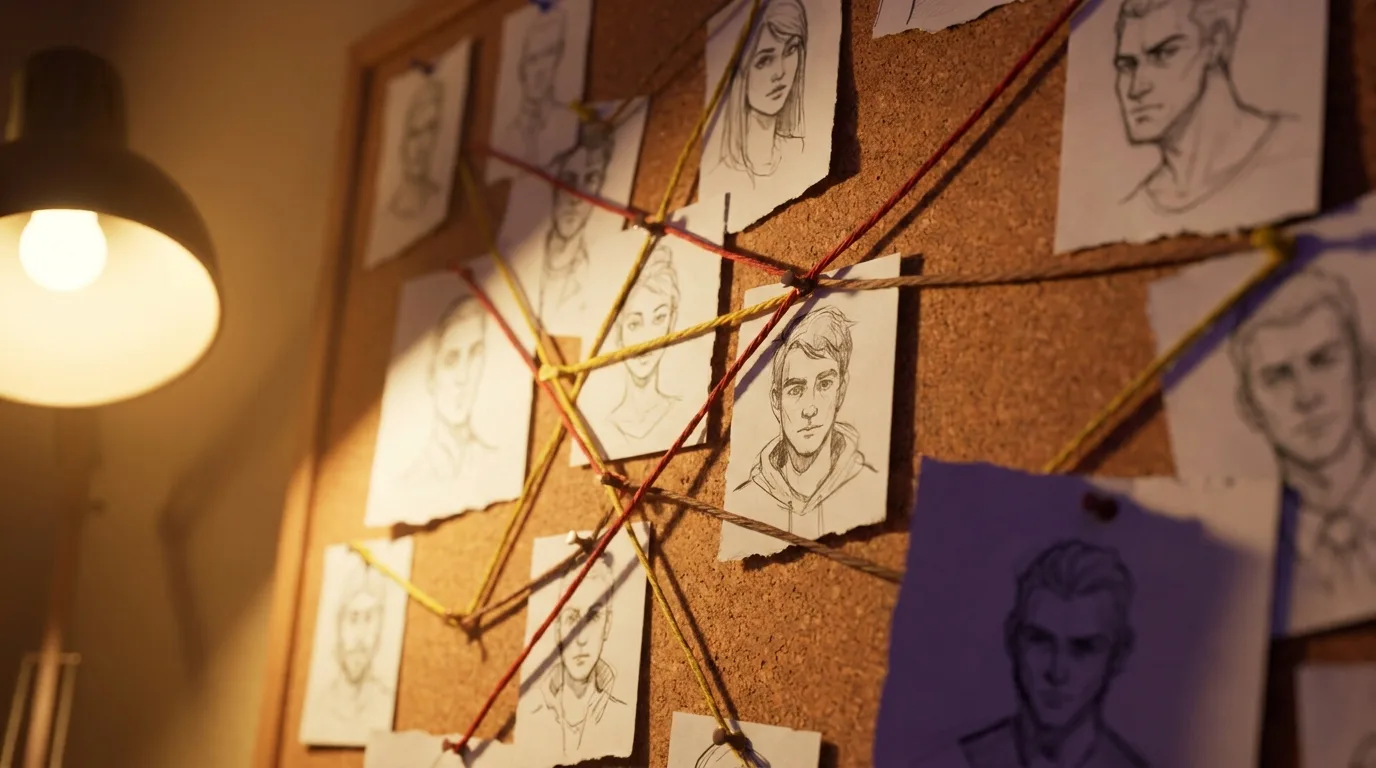
A visual map solves the problem at the root: characters become nodes, relationships become connections between the nodes, and the whole web is visible at a glance instead of being pieced together by reading separate sheets one by one. It's especially useful once your cast passes about ten characters, the point where a text list stops being readable at a glance.
The relationships that matter most to the plot, not every relationship that technically exists in the novel, are also the only ones worth mapping. A minor character who appears twice doesn't need a web of connections; the protagonist with five different bonds evolving chapter after chapter does.
What are the most common continuity errors, and how do you catch them early?
Continuity errors tend to cluster into four recurring categories, based on experience shared by serial fiction writers (Amanda Blackmere's Substack on the continuity problem, accessed 2026-08-03):
Physical inconsistencies: the green eye that turns brown, the height that shifts, the scar that appears or disappears without explanation.
Psychological inconsistencies: a character acting against their established motivations, without the change being told as an evolution.
Plot inconsistencies: a dead character reappearing, a lost object turning back up without ever being found.
Timeline inconsistencies: events happening in an order that's impossible given what was established earlier.
The most effective way to catch them isn't rereading the entire manuscript hunting for mistakes (it works, but it costs hours you might not have); it's having the correct information visible in the same place where you're writing the scene, so the error never gets a chance to happen.
Professional developmental editing, the kind that among other things catches exactly this type of inconsistency, costs on average between $1,600 and $9,600 for an 80,000-word novel (Inkshift, 2026 editing cost guide, accessed 2026-08-03). Every inconsistency you fix yourself before the edit is, literally, time and professional editing fees you won't have to pay someone else to point out.
How does GrinTale handle all this?
The three needs described so far, a complete sheet, chapter linking, a relationship map, are exactly the three points where GrinTale is built differently from a generic text document, the same differentiator we highlighted in our comparison between GrinTale and Scrivener. If you're still weighing multiple tools against each other, our roundup of the best writing apps for multilingual writers covers this angle too.
Character sheets cover the four areas described above (identity, physical appearance, psychology, story arc) in a dedicated module, not a separate file. Every character links to the specific chapters where they appear: open the chapter, open the sheet for the character involved, no switching windows or hunting through another document.
The built-in mind map lets you visually connect characters, chapters, and project material: the relationships that matter become linked nodes you can check at a glance, instead of piecing them together by reading separate sheets.
The practical result: chapter 20 and the sheet for the character who appears in it are one click apart, not two separate files you have to keep in sync by hand. That's the difference between a sheet you check the first few times and a sheet you check every time, because it costs no more effort than a scroll.
For other practical questions, including how to import a manuscript you already started elsewhere, check the GrinTale FAQ. If you want to try character sheets and the mind map on your own novel, start with 15 days free, no credit card required.
Checklist: 6 checks before you submit your manuscript
Does every character who appears more than once have a sheet, even a minimal one? Secondary characters who resurface many chapters later are the most common source of physical inconsistencies.
Are the physical traits consistent from the first chapter a character appears in to the last? Check eyes, height, scars, or other distinguishing marks in particular.
Is it clear who's alive and who's dead at every point in the story, without having to reconstruct it from memory? It's the hardest continuity error to catch on your own during revision.
Do the main relationships (who loves whom, who betrays whom, who's related to whom) stay consistent across the whole plot? If there are more than 4 or 5, it's worth mapping them visually instead of keeping them in your head.
Does a character ever act against their established motivations without it being told as a change? If so, either it's an intentional arc, or it's a mistake to fix.
Can you answer "where is this character right now" for every chapter, without rereading the whole book? If the answer is no, the timeline isn't visible enough yet while you write.
Frequently asked questions
How many characters can I keep track of before I need a dedicated sheet?
There's no fixed threshold, but the practical signal is clear: the moment you search your manuscript with Ctrl+F for a secondary character's name because you can't remember it, memory alone isn't enough anymore, regardless of the exact number.
Is it worth creating a sheet for minor characters too?
Yes, at least a minimal version with a name, role, and one line of physical description. Minor characters who resurface many chapters later are, in practice, the most common source of physical inconsistencies readers notice.
What's the difference between a character sheet and a character bible?
They're the same concept under different names: a character bible is typically the full set of character sheets for a novel, often paired with maps, timelines, and world-building rules, all gathered into one central reference (ProWritingAid, guide to the character bible, accessed 2026-08-03).
Do I need to map relationships even in a novel with few characters?
Not really, under about ten characters a text list stays perfectly readable. It becomes useful once your cast grows enough that a bulleted list gets hard to scan at a glance.
In summary
Losing track of your characters in a long novel isn't a sign of poor organization, it's what happens when the volume of information outgrows what memory can manage without a system. The fix isn't remembering more, it's making the right information visible the moment you're writing: a complete sheet for every character, linked to the chapters where they appear, and a relationship map once the cast calls for one. If any of this sounds familiar, it's a good time to take a look at a tool like GrinTale, built specifically to hold these three things together without one more document to sync by hand.
SOURCES
Fantasy-Writers.org, "How Many Characters?", accessed 2026-08-03, https://www.fantasy-writers.org/content/how-many-characters
Wikipedia, "List of The Wheel of Time characters", accessed 2026-08-03, https://en.wikipedia.org/wiki/List_of_The_Wheel_of_Time_characters
Amanda Blackmere (Substack), "The Continuity Problem Nobody Warns You About", accessed 2026-08-03, https://amblackmere.substack.com/p/the-continuity-problem-nobody-warns
Inkshift, "How Much Does Book Editing Cost? 2026 Rates", accessed 2026-08-03, https://inkshift.io/resources/editing-cost-2026
ProWritingAid, "How to Create and Use a Character Bible for Your Novel", accessed 2026-08-03, https://prowritingaid.com/art/717/how-to-create-and-use-a-character-bible-for-your-novel.aspx
Pronto a scrivere il tuo prossimo capolavoro?
15 giorni gratis, nessuna carta richiesta.