Standard Manuscript Format for Publishers and Agents
A badly formatted manuscript does not get rejected for its formatting. It does get read with less patience, and it tells an agent within three seconds that the writer does not know the conventions of the trade. The good news is that standard manuscript format is simple, you set it up once, and it requires no design skill at all: the goal is not to make your pages look like a book, it is to make them neutral and easy to read.
In brief
One font throughout, 12 point Times New Roman or Courier New, black type only (William Shunn).
Double spacing, one inch margins on all four sides, indented paragraphs (William Shunn).
Length is measured in words, not pages, and stated as a rounded figure such as "about 80,000 words" (William Shunn).
A separate title page for a novel, a running header on every page, numbering that starts on the first page of text.
Each chapter starts on a new page.
The agency's own guidelines, when they exist, beat any general standard.
What is standard manuscript format?
A single serif or monospaced font at 12 point, double spaced, with one inch margins, numbered pages and a title page carrying the essentials. Nothing more.
The principle behind these choices explains every rule that follows: a manuscript is not supposed to look like a printed book. It has to be easy to read for someone who reads dozens of submissions a week, and easy to work on for the people who will edit it later. Every personal typographic flourish, however careful, pushes in the opposite direction.
William Shunn, whose guide is the reference most editors and agents point to, puts it in one line: you want to impress an editor with your content, not your font choice (William Shunn, Proper Manuscript Format). Any design work you do now will be thrown away when the book is typeset, so keep it plain.
Which font and size should you use?
Times New Roman or Courier New, 12 point, one font for the whole manuscript (William Shunn).
Courier is the traditional typewriter choice and some editors still prefer it, because a monospaced font makes the text easy to scan and estimate. Times New Roman is the more common choice today and nobody will object to it. Either is fine. What is not fine is anything decorative.
The one font rule is the one broken most often. Chapter titles in a different typeface, a dedication in a script font, epigraphs in a third font: these all read as amateur, not as careful. If a chapter opening needs to stand out, it stands out through white space and position on the page, not through a change of typeface.
Bold has no place in the body of a novel. Italics do, for what italics are actually for: direct thoughts, titles of works, foreign words.
What line spacing and margins?
Double spacing and one inch margins on all four sides (William Shunn).
This is where the English language standard is stricter than many others. Elsewhere 1.5 spacing is often tolerated, but in submissions to agents and publishers in the US and UK, double spacing is the expected default and anything tighter gets noticed. Wide spacing gives the reader room to breathe and leaves space for notes between the lines.
On paragraph indents there is one technical rule: never use the Tab key or a row of spaces. Set the first line indent in the paragraph settings, usually half an inch, otherwise the layout falls apart the moment someone opens the file with settings different from yours. And do not add blank lines between paragraphs: in a manuscript, paragraphs are separated by the indent alone.
Paper size follows your market. Letter for the United States, A4 for the United Kingdom and most of the rest of the world. Nobody will reject a file over it, but matching the market is a small signal that you know where you are submitting.
How do you count and state the word count?
Use the word count from your writing software and round it to a clean figure. The industry measures length in words, never in pages.
Shunn's sample novel title page states the length as "about 80,000 words" (William Shunn, Proper Manuscript Format: Novel), and that is the convention: round to the nearest thousand for a novel. Nobody needs to know that your book is 81,347 words long, and a precise figure looks like inexperience rather than rigour.
The reason the industry counts words rather than pages is that a page means nothing. The same text fills twice as many pages with a larger font and wider spacing, while the words stay the same. To check whether your length fits the expectations of your genre, see how many words a novel should have.
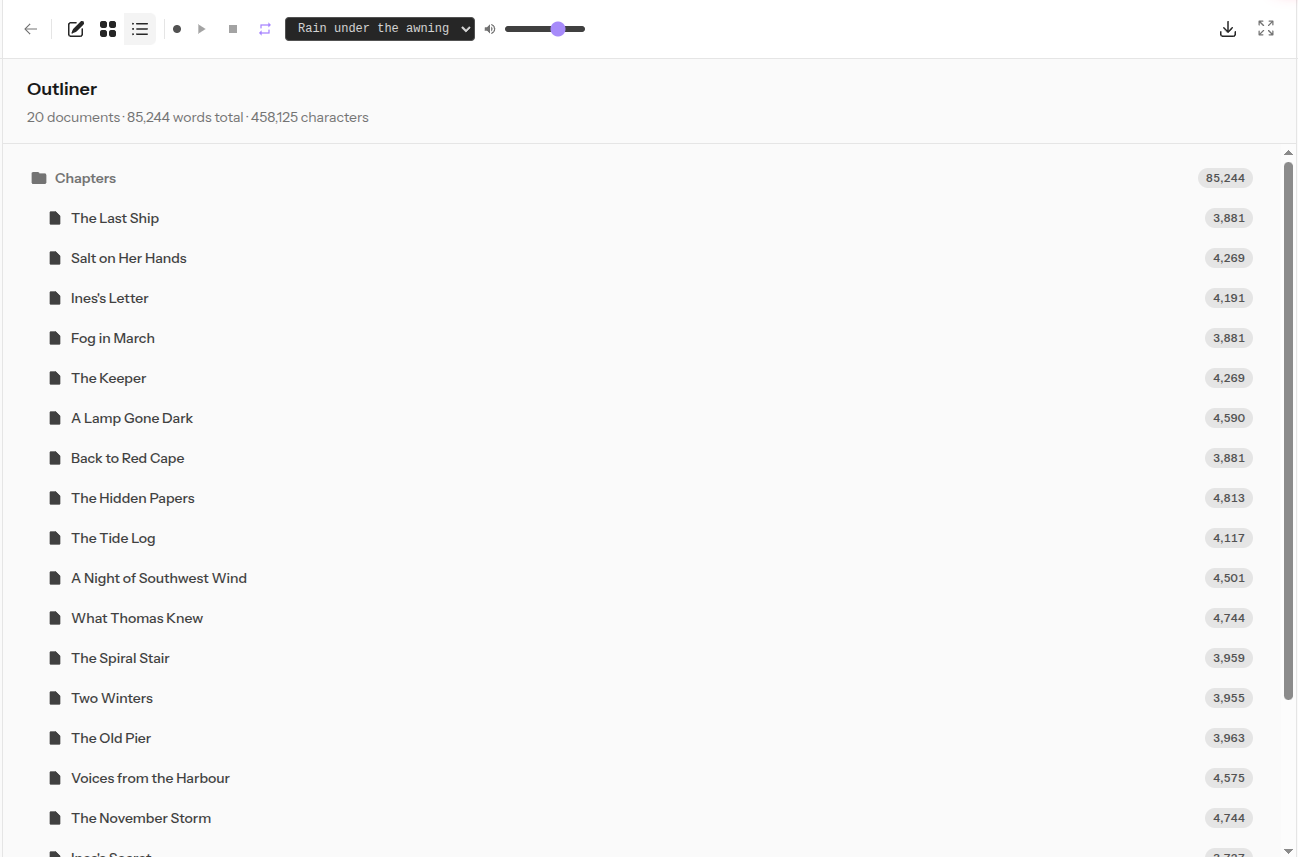
If you write in GrinTale, the number is already there. The Outliner view shows the word count of the whole manuscript, updated every time you save, so the figure for your title page is always one glance away. If you want to try it, you get 15 days of GrinTale free, no card required.
What goes on the title page?
A novel gets its own title page, and it carries only four things: your contact details, the approximate word count, the title and your name (William Shunn, Proper Manuscript Format: Novel). No images, no epigraphs, no cover mockups.
Contact details go in the top left corner: legal name, address, phone, email. The word count goes in the top right. The title and byline sit in the middle of the page.
If you write under a pen name, the title page carries both: the pen name in the byline and your legal name in the contact block, because any contract will be signed with the second.
Every following page gets a running header with your surname, a short form of the title and the page number, for example Surname / Title / 2. It serves one purpose, but an important one: if someone prints the file and the pages get mixed up on a desk, each one can still be identified and put back in order.
Numbering starts with 1 on the first page of actual text, not on the title page (William Shunn, Proper Manuscript Format: Novel). And each chapter begins on a new page.
Which file format should you send?
Whatever the agency asks for, which in practice usually means .doc or .docx, or the opening pages pasted into the body of an email.
Many agents explicitly ask for sample pages pasted below the query rather than attached, because attachments from unknown senders are a security risk. Follow those instructions to the letter. When an attachment is requested and no format is specified, a Word file is the safest choice, because it is what editors work in. Send a PDF only when the guidelines allow it.
After a contract is signed, the publisher will always want an editable file, because the text will be edited and typeset from it. Images, if there are any, are supplied as separate high resolution files and never pasted into the text document.
The file name matters more than it seems. Surname_Title.docx can be found in a folder with three hundred attachments, novel_final_v2.docx cannot.
What is the difference between submission format and house style?
This distinction confuses a lot of first time writers, and it is worth keeping clear because it changes what you have to do and when.
Submission format is what this whole article is about: how to present a manuscript when you send it to an agent or publisher who does not know you. It is a general convention, the same for everyone, and its only job is to let you be read without friction.
House style is a set of rules the publisher applies once the book is under contract, covering how the text is prepared for print: quotation marks, numbers, capitalisation, spelling variants, the handling of notes. It is far more detailed and it differs from publisher to publisher.
You do not need to apply a publisher's house style when you query. The copyeditor will apply it later, if the book is acquired. The one exception is when an agency or publisher states explicit formatting instructions on its submissions page: in that case those instructions beat any general standard, every time. The full submission process, from the query letter to choosing agents, is covered in how to submit a manuscript to a publisher.
The mistakes that get noticed immediately
Some flaws jump out before the first sentence, and all of them can be fixed in five minutes.
Several fonts in one document, or a decorative font for chapter headings.
Blank lines instead of indents, or indents made with tabs and spaces.
Single spacing on a long text, which makes reading tiring after a few pages.
Two spaces after a full stop, a typewriter habit that copyeditors flag at once.
Missing page numbers, or numbers on only some sections.
Graphic elements: cover mockups, illustrations, borders, coloured headers.
An unproofread text. It is the only formatting flaw that no setting can fix.
Frequently asked questions
Should the text be justified or left aligned?
Left aligned, with a ragged right edge. Justified text creates uneven gaps between words in a manuscript, and left alignment is the standard expected by agents and editors in the English language market.
How many words per page in a manuscript?
In standard manuscript format, roughly 250 words per double spaced page. That is only an estimate, which is exactly why the industry relies on the word count and not on page numbers.
Does the title page get a page number?
No. Numbering starts with 1 on the first page of text (William Shunn). The title page has no number and no header.
Can you use a different font for chapter titles?
Better not. A single font throughout is the rule editors repeat most often, and chapter titles are distinguished by position and white space, starting on a new page.
Single or double spacing?
Double. It is part of standard manuscript format along with 12 point type and one inch margins (William Shunn).
In summary
Standard manuscript format fits in one line: a single 12 point font, double spacing, one inch margins, indented paragraphs, numbered pages with a running header, a title page with the essentials and a rounded word count.
It is not a test of skill and it wins nothing on its own. It simply removes every bit of friction between your text and the person who has to read it, and gives nobody a reason to close the file before the first page.
Once the manuscript is formatted, the next piece of the package is the plot summary: see how to write a novel synopsis.
Sources
William Shunn, Proper Manuscript Format, retrieved 2026-10-12, https://www.shunn.net/format/story/
William Shunn, Proper Manuscript Format: Novel, retrieved 2026-10-12, https://www.shunn.net/format/novel/
Pronto a scrivere il tuo prossimo capolavoro?
15 giorni gratis, nessuna carta richiesta.