How to Write 50,000 Words in a Month: A Plan for November

Writing 50,000 words in a month means producing the draft of a short novel in thirty days, without ever going back. NaNoWriMo has closed, but the November challenge has survived: some writers take it on through one of the platforms that appeared afterwards, others do it alone. Either way, the difference between those who reach the end and those who stop in the second week is rarely talent. It is almost always the plan.
In brief
50,000 words in 30 days is 1,667 words a day. Take Sundays off and it becomes 2,000 words a day for 25 days.
Finishing is hard: back in the NaNoWriMo years, 11% of participants made it in 2012 and 14% in 2013 (Chris Baty).
October is for preparing a premise, characters and a list of scenes, not for writing.
There are four milestones to check: 11,669 words on 7 November, 23,338 on the 14th, 35,007 on the 21st, 46,676 on the 28th.
If you fall behind, spread the gap over the remaining days rather than trying to make it up in one night.
What you end up with is a first draft: December is for rest, revision comes later.
How many words a day do you need to reach 50,000?
1,667 words a day, every day, from 1 to 30 November. That is the number to start from, but it is not the only way to split the month.
It depends on how many days you actually have. November 2026 starts on a Sunday and has five Sundays, so the most common options are these:
All 30 days: 1,667 words a day.
Sundays off (25 writing days): 2,000 words a day.
Weekdays only (21 days): about 2,380 words a day.
Light weekdays, long weekends: for example 1,200 words Monday to Friday (25,200 in total) and about 2,750 on each of the nine Saturdays and Sundays.
None is better than the others. What matters is choosing one before 1 November and writing it down, because the daily number is the only thing you will check every evening. If 50,000 words feels like an arbitrary target, that is because it is: in most genres a published novel is much longer, as the guide to how many words a novel should have shows. Fifty thousand is the point where a draft has taken shape, not the length of a finished book.
How many people actually finish?
Not many. The figures NaNoWriMo published at its peak are clear: in 2012, 38,438 of 341,375 participants reached 50,000 words, or 11% (NaNoWriMo, 2012 stats). In 2013 there were 42,221 winners out of 310,095, or 14% (Chris Baty, NaNoWriMo 2013 by the numbers).
That is not meant to discourage you. It tells you something useful: most people do not stop because they cannot write, but because at some point the numbers stop adding up and they have no plan to get back on track. If you know in advance that the second week will be the hardest, and you have already decided what to do when you fall behind, you have a concrete advantage over nearly nine people in ten.
How do you prepare in October?
October is for removing from November every decision that is not writing. The community calls this month of preparation Preptober, and Novel November, the free challenge run by ProWritingAid, opens its 2026 edition with preparation starting on 1 October (ProWritingAid, Novel November).
Before 1 November you need five things:
A two sentence premise: who wants what, and what stands in the way. If you cannot write it, the novel is not ready to start.
Your main characters, each with a name, a desire and a fear. A few lines are enough, you will discover the rest as you write.
A list of 30 scenes, one per day, even if each is just a five word title. It is not a rigid outline: it is the answer to "what do I write today?" at eleven at night, when you are tired.
A fixed time to write, the same every day. A writing routine holds up better than motivation, which runs out halfway through the month.
A measure of your speed: in October, do three 30 minute sessions and count how many words you produce. That way you know how much time your 1,667 words really take, instead of finding out on 3 November.
The one thing not to do in October is start writing the novel. Words written before 1 November do not count for the challenge, and above all they burn the energy of the start.
How do you split the month week by week?
With four milestones to check, not thirty. If you write every day, at the end of each week you should be here:
7 November: 11,669 words. The first week is the easiest. The typical mistake is writing far more and spending all your energy: if you are ahead, fine, but do not raise your daily target.
14 November: 23,338 words. The second week is when people quit. The novelty has worn off, the story is widening and the middle of the novel seems to lead nowhere. That is normal. This is where the scene list you prepared in October makes the difference.
21 November: 35,007 words. In the third week the story usually picks up speed again, because you start to see the ending. This is the moment to make up any gap.
28 November: 46,676 words. A little over 3,300 words left in two days. If you are on track, the finish line is within reach.
On 30 November you reach 50,010. Check the total only once a week, not every hour: constant counting pushes you to reread and correct, which is exactly what November is not for.
What should you do when you fall behind?
Spread the gap over the days that remain, instead of trying to recover it all at once.
An example. On 15 November you are at 20,000 words instead of 25,000: you need 30,000 words in 15 days, which is 2,000 a day instead of 1,667. That is 333 extra words a day, about twenty minutes for many people. A 5,000 word marathon on a Sunday, on the other hand, is usually paid for with two empty days right after.
When the problem is not time but the scene itself, there are three ways to keep moving:
Skip the hard scene. Write in square brackets what has to happen, for example "[they argue and she leaves]", and move on to the next one. You will fix it in January.
Write in 25 minute blocks. With a timer and without rereading anything until it rings. The block often loosens after the first five minutes.
Do not delete. A bad sentence is still a sentence. If a version does not convince you, write the second one underneath and keep going: you will decide later which to keep.
And if on 25 November you realise you will not reach 50,000, you have not failed at anything. Thirty thousand words of a novel that did not exist in October are thirty thousand more than you had before.
Can you write a good novel in a month?
You can write a complete first draft in a month, which is something different and just as valuable.
What comes out of November is raw material: repeated scenes, characters who change name halfway through, chapters to cut. That is normal, and it is why the method works. Completely separating the phase in which you write from the phase in which you judge removes the fear of the wrong page, which is what stops most drafts.
Keep the length in mind too. Fifty thousand words is a short novel: a complete genre or literary novel often needs 70,000 or more, so the November draft can be the larger first half of something longer.
How to set up the challenge in GrinTale
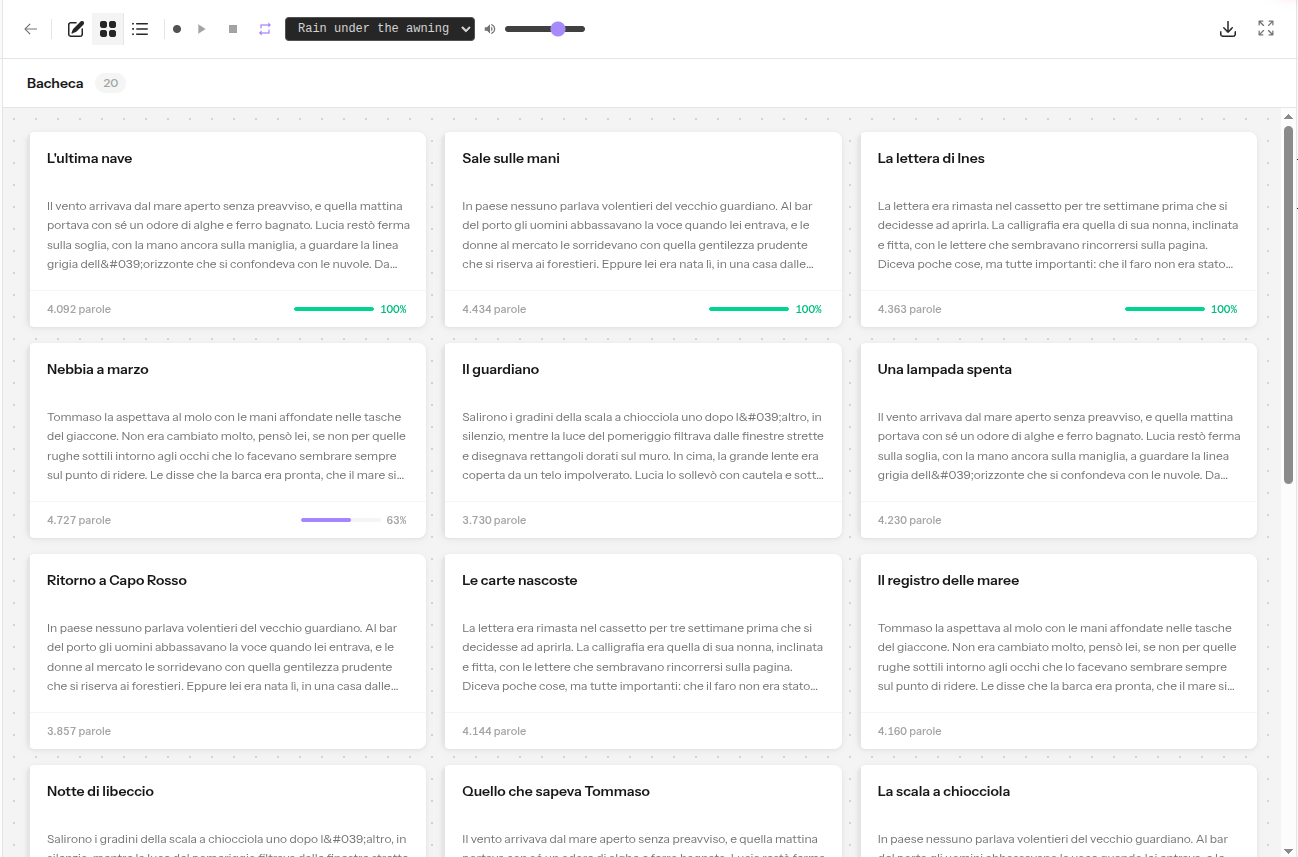
If you write in GrinTale, you can set up November so that the app keeps count instead of a spreadsheet.
One document per day, or per scene. Create the documents from the scene list you prepared in October and give each one a 1,667 word target (or your own daily number) in the Inspector. The progress bar fills as you write.
The Corkboard as a calendar. Every document is a card showing its word count and its completion percentage against the target: at a glance you see which days are done and which are not.
The Outliner for the total. At the top of the Outliner view you find the total word count of the manuscript, the number to compare with your weekly milestones.
Zen Mode for timed sessions. It hides everything except the text, and the audio player in the editor toolbar gives you a background for your 25 minute blocks.
You can try GrinTale free for 15 days, no card required, then it costs €29 a year.
What should you do on 1 December?
Nothing, for at least two weeks. The draft needs to rest before you reread it, because right after the challenge you cannot see it clearly: you remember what you meant to write, not what you actually wrote.
When you pick it up again in January, the work changes nature. Structure first, then scenes, sentences last: the guide on how to organise a novel starts exactly there. And if your goal is to reach an agent or a publisher, the first document to write after revision is the synopsis.
Frequently asked questions
Can I do the challenge with a novel I have already started?
Yes. The rule that matters is to count only the new words written in November. Note the manuscript's total on 31 October and measure the difference.
Does it work for a dissertation, a nonfiction book or a story collection?
Yes, the method is the same for any long text. For a dissertation the preparation changes: instead of a scene list you need the table of contents, as explained in the guide on how to structure a dissertation.
Do I need to sign up to a platform to take part?
No. The platforms that appeared after NaNoWriMo offer community, shared writing sprints and badges, and many people find them helpful. But the challenge works alone too: you will find the options compared in NaNoWriMo alternatives.
Is it better to start with an outline or to write by the seat of your pants?
A scene list is the compromise that works for most people: enough to know what to write each day, light enough to change when the story takes another turn.
How much time a day do 1,667 words take?
It depends on your speed, which is why it is worth measuring in October. Count how many words you write in 30 minutes without correcting and scale it up: that is the time to block out in your calendar every day.
In summary
Writing 50,000 words in November takes 1,667 words a day, a month of preparation in October and a plan for the days when you fall behind. There are four milestones to check, one per week, and the hardest is the second.
The result is not a finished book, it is a complete first draft. That is exactly what you need: the raw material from which the real work begins in January.
Sources
ProWritingAid, Novel November 2026, retrieved 2026-10-12, https://prowritingaid.com/novel-november
NaNoWriMo, 2012 NaNoWriMo Stats: Bigger and Better Than Ever (Chris Baty's blog), retrieved 2026-10-12, https://www.goodreads.com/author_blog_posts/3401933-2012-nanowrimo-stats-bigger-and-better-than-ever?tab=book
Chris Baty, NaNoWriMo 2013: By the Numbers, retrieved 2026-10-12, https://www.goodreads.com/author_blog_posts/5408566-nanowrimo-2013-by-the-numbers?tab=author
Pronto a scrivere il tuo prossimo capolavoro?
15 giorni gratis, nessuna carta richiesta.