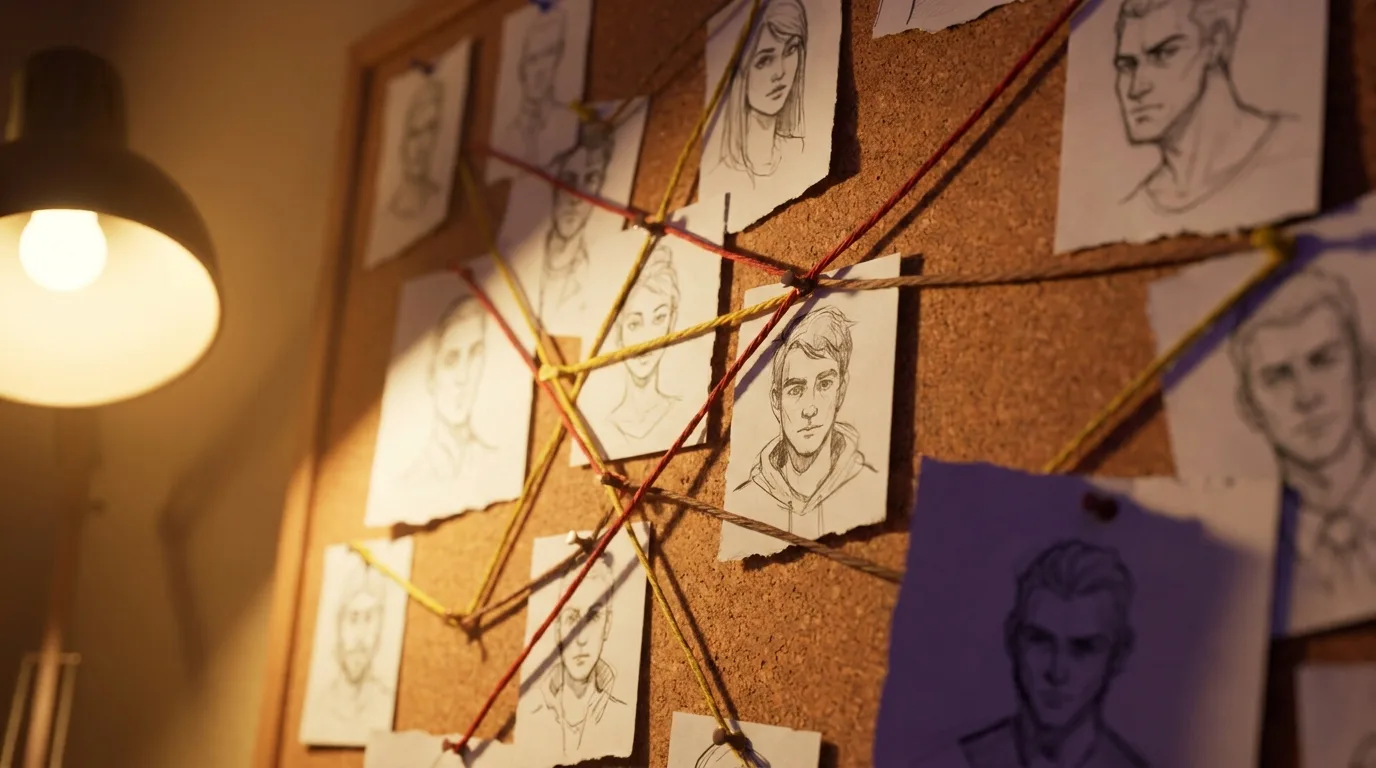
How to Organize a Novel: the Complete Guide
Organizing a novel isn't deciding the plot. It's building the system that lets you find, twelve months later, the chapter where you first named your protagonist's sister.
Those are two different problems, and almost every guide solves only the first. Three acts, the hero's journey, ideal chapter length. Then it leaves you alone with ninety thousand words scattered across twenty eight files named things like "ch12_v3_FINAL_actualfinal.docx".
This guide covers both. Narrative structure first, because you need it. Then working structure, which is what decides whether you finish.
What's in this guide
The difference between narrative structure and working structure, and why confusing them costs months
Whether you actually need an outline before you start
How to divide a novel into chapters, with reference lengths by genre
Where to keep everything that isn't the text: characters, places, timeline, research
How to track the state of every chapter through revision
The four organizational mistakes that cost the most time
What does organizing a novel actually mean?
It means keeping apart two things that look like one: how the story is built and how your work on the story is built.
Narrative structure is the shape of the story for the reader: where tension rises, where it drops, when the reveal lands. Working structure is how you hold the material while you write it: where each scene lives, what it's called, what state it's in, where you noted that this character has green eyes in chapter three.
The first you can change a thousand times. The second, if you get it wrong, slows you down every single day.
Most first time novelists pour everything into the first and improvise the second. Then revision arrives and they discover the real cost was never writing. It was finding.
What almost nobody says: a novel isn't lost for want of ideas. It's lost for want of an address. You know the scene exists, you know you wrote it, you can't find it.
Do you need an outline before you start?
It depends, and the honest answer is less ideological than the plotter versus pantser argument suggests.
An outline helps if you're writing a genre with an explicit promise to the reader. A mystery has to plant its clues before the solution, and planting them after you've found it is far harder. A thriller lives on pace, and pace is designed. Historical fiction has external constraints you can't move.
An outline helps less, and can actively hurt, if you're writing a novel of voice, where discovery is the engine and plot is nearly a pretext.
There's a third path that works for most people in practice: the retroactive outline. Write three or four chapters without knowing where you're going, then stop and map them. You aren't planning in the abstract, you're reading what your instinct already decided. From there an outline becomes possible, and it's almost always better than the one you'd have written cold.
How this plays out in real work: whatever your method, the one line synopsis for each chapter has to get written. Not before, not after: during. The moment you close a chapter, write one line saying what happens in it. By the end you'll have an outline of the novel you actually wrote, which is the only document that's useful in revision.
Which narrative structure should you choose?
The classic structures are maps, not rules. They exist to tell you where you are when you get lost, not to decide what you write.
Three acts. Setup, development, resolution. The most elastic and the most common. The critical stretch is act two, twice as long as the others, and where most unfinished novels die.
The hero's journey. Useful for fantasy and coming of age stories. Risky taken literally: it produces plots readers recognise after thirty pages.
Four part structure. Splits act two into two halves separated by the midpoint. In practice it's the most useful variant of the three act model, because it addresses exactly the stretch that sags.
Sequence structure. The novel as eight blocks of eight or ten chapters, each with its own arc. Works well for episodic writers and for ensemble novels.
None of them will tell you how long act two should run. They answer one question, and only when you're stuck: where am I in the story, and what still has to happen before the end?
How do you divide a novel into chapters?
A chapter ends where the reader could get up, and doesn't want to.
That's the only criterion that always holds. Everything else follows from it: a change of viewpoint, a time jump, a change of place, one tension closing as the next opens.
On length it's worth having reference points, as long as you know they're market conventions and not laws. Current ranges for adult fiction sit roughly between 50,000 and 110,000 words overall, with genre differences: fantasy runs 90,000 to 120,000, thriller and romance 70,000 to 90,000, science fiction 70,000 to 100,000, while young adult sits between 50,000 and 80,000 (From Whispers to Roars, Average Novel Word Count by Genre, retrieved 2026-08-18).
For an individual chapter the current reference range in adult fiction is 2,000 to 4,000 words (Jericho Writers, How Long Should a Chapter Be?, retrieved 2026-08-18).
The count works itself out from there. A 90,000 word novel with 2,500 word chapters has thirty six. With 4,000 word chapters it has twenty two. Neither is more correct: the first gives speed, the second gives depth.
That there's no correct number is something the books themselves demonstrate. 1984 has 24 chapters, A Game of Thrones has 60, The Amazing Adventures of Kavalier and Clay has 75, and Along Came a Spider has 97 (Jericho Writers, retrieved 2026-08-18).
Three things that matter more than length:
Regularity or variation, but chosen. The sources disagree here, and it's worth knowing: some advise chapters of similar length, others explicitly advise mixing them, because short chapters break up the rhythm of the rest. Both work. What doesn't work is the third option, lengths nobody decided.
One chapter, one question. If you can't say which question the chapter opens and which one it leaves open, it's probably two chapters or none.
Don't switch viewpoint mid chapter. If you change heads, change chapters. This holds even if you're very good.
Where do you keep everything that isn't the text?
This is the part the guides skip, and the part that costs you most.
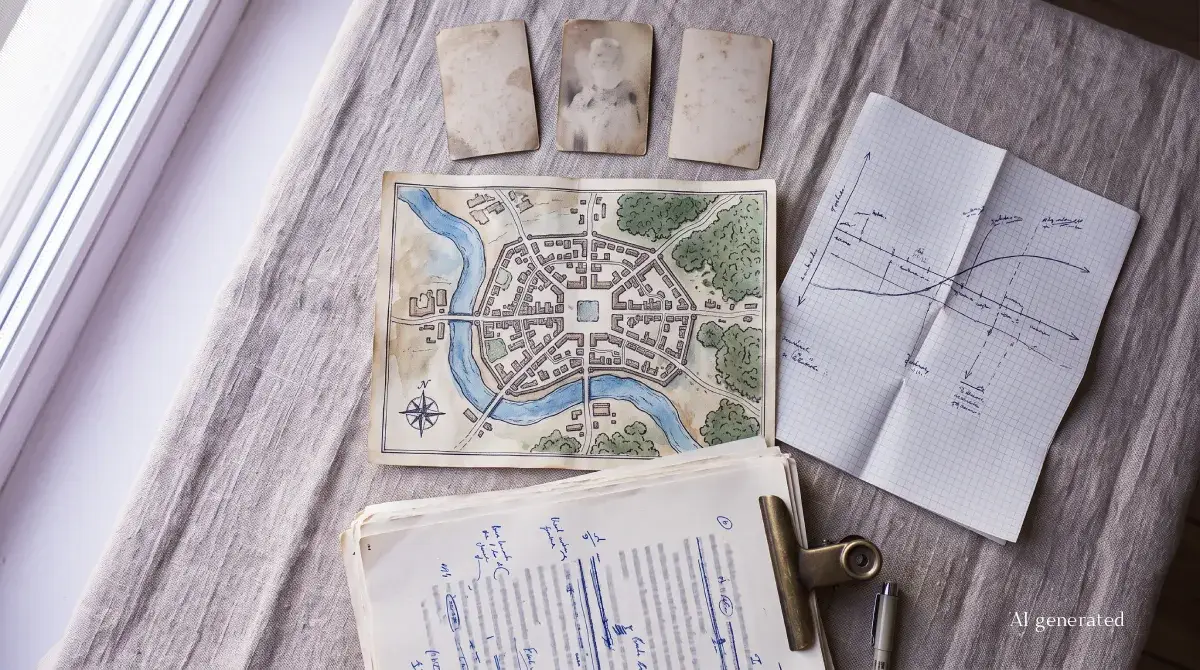
A novel generates a quantity of material that isn't the novel: names, ages, eye colours, the map of the invented city, the chronology of events, three pages of nineteenth century research you read to write two lines, and the cut scenes you might still recover.
If that material lives in scattered files, different notebooks and phone notes, it's working against you. There's one rule: it has to sit next to the manuscript, not somewhere else.
The minimum organization that works for nearly everyone:
Characters. One file each, secondary characters included. You don't need to fill it in at the start: you need one single place to record that the brother is called Andrew, not Albert. We covered this in detail in link.
Places. Same logic. Inconsistencies about places are the most visible in reading and the most tedious to fix afterwards.
Chronology. Even just a list of dates and seasons. You'll want it the fourth time you write "three months later".
Research. With the source link, always. The version of you who read that article in April is gone by June.
Cuts. A folder where deleted scenes go. Never delete: move. Cutting gets much easier once you know the text doesn't vanish.
The bit that changes the work: your project's folder tree shouldn't mirror the novel's structure. It should mirror how you work on it. If you write alternating viewpoints, a folder per character beats a folder per part, even though the finished book will be divided into parts.
How do you track the state of each chapter?
With one label per chapter, and the discipline to keep it current.
It sounds like bureaucracy. It's the opposite: it's what lets you open the project after two weeks away and know in thirty seconds where to pick up, instead of rereading four chapters to work it out.
A status scheme that works without weighing you down:
To write. It exists as a title and a synopsis. The text doesn't.
First draft. Written, ugly, fine.
To revise. Written, and you already know what's wrong with it.
Revised. Been through at least one critical pass.
Closed. You don't touch it again, barring plot problems.
Alongside the status you need a second piece of information almost nobody keeps: what's waiting for you in that chapter. A one line note like "confrontation scene missing" or "check the date on the letter" saves half an hour of rereading every time you come back.
How does organization change in revision?
It changes job. While drafting you organize so you don't get lost. In revision you organize so you can compare.
Three things you need that you didn't need while drafting:
Versions. Before a structural revision you have to be able to go back. Undo isn't enough: you need a snapshot of the chapter as it was before you touched it, recoverable weeks later.
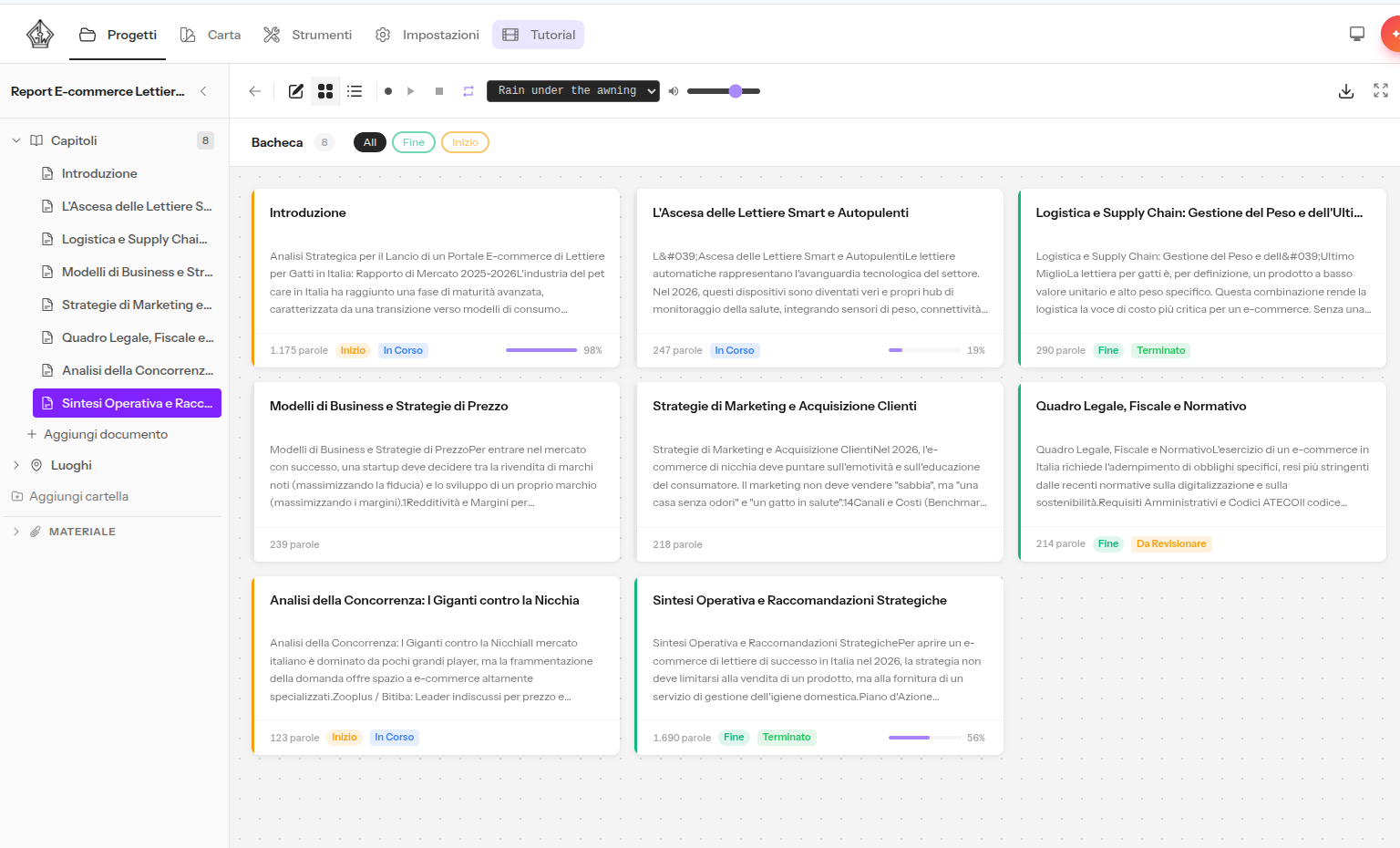
The overview. In revision the single document lies. You need every chapter side by side with its synopsis and its length, because that's where pacing holes show up: four short chapters in a row, or one eight thousand word chapter among two thousand word ones.
Reading order versus writing order. They're almost never the same. Being able to move a chapter without renaming files is the difference between trying a solution and giving up on trying.
Worth noting: structural revision, the kind where you move and cut whole chapters, comes before line revision. Polishing the sentences of a scene you'll later delete is the most efficient way to demoralise yourself.
The four mistakes that cost the most time
File names instead of a structure. "ch12_v3_final" isn't organization, it's postponement. Every version in a filename is a decision you didn't make.
The synopsis left until the end. Written after the draft it's archaeology. Written chapter by chapter it's a tool.
Support material in another application. Every window switch is an invitation to leave the writing, and you take it.
No cuts folder. People with nowhere to put deleted text don't delete. And a novel that never gets cut never gets finished.
How you organize a novel in GrinTale
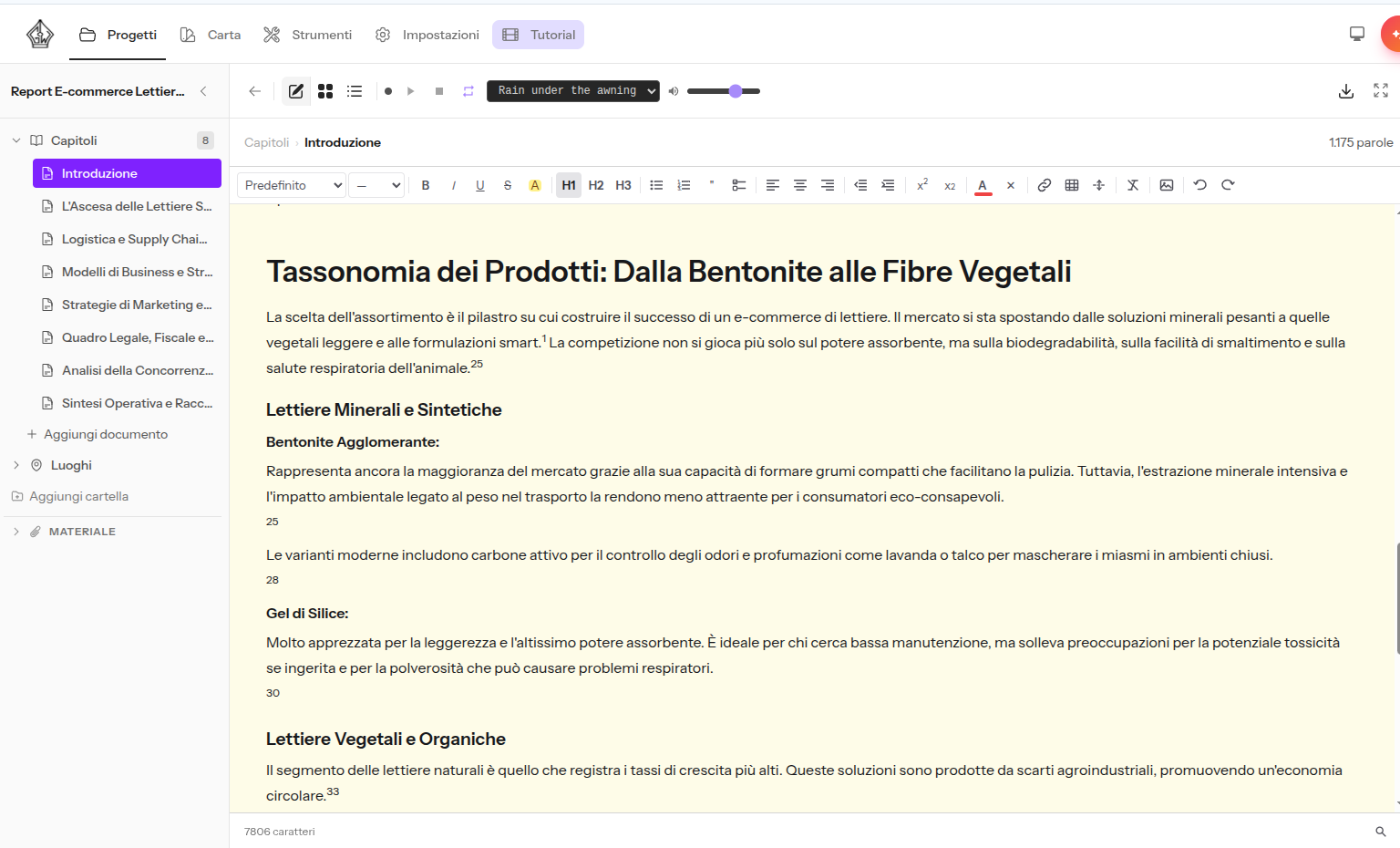
Everything above can be done with folders, a notebook and a lot of discipline. GrinTale exists to remove the portion of discipline that only compensates for the tools.
Point by point:
The Binder is the project tree in the left column: folders and documents nested without depth limits, reorderable by dragging, with custom icons so you recognise parts, chapters and materials at a glance.
Character files live inside the project, not in a separate document. Identity, appearance, psychology, history, photo, and the link to the chapters the character appears in.
The Inspector holds, for each document, the synopsis, the status, a free label, notes and the word target bar. It's exactly the status and notes scheme described above, without having to invent it.
The Corkboard shows every chapter as a card with synopsis, word count and completion percentage. It's the overview revision requires.
Snapshots save a picture of the document in one click and let you restore any earlier version. No more "v3_final".
The Material section keeps images, PDFs and research files inside the project, next to the text.
The GrinTale Encyclopedia and Dictionary open in a side panel inside the editor, so a quick check doesn't become twenty minutes in a browser.
If the novel is already underway somewhere else, the Word import brings it in and detects chapters, offering to split them into separate documents instead of dropping one solid block on you. We covered that in link.
You can try it free for 15 days, no card required.
Try it now → https://grintale.it/register
In short
Organizing a novel is work on two levels. The narrative level decides what the reader reads, and for that any of the classic maps will do, plus the discipline of writing one synopsis per chapter as you go rather than afterwards.
The operational level decides whether you get to the end, and it rests on four things only: a folder tree that mirrors how you work, support material next to the text rather than elsewhere, a readable status on every chapter, and the ability to go back without fear.
The rest is writing. Which is the hard part, but at least it's the right part.
If you're weighing up tools, see also link and link.
Frequently asked questions
How many chapters should a novel have?
There's no correct number. You get it by dividing your target length by the average chapter length you want to hold: a 90,000 word novel with 2,500 word chapters has about thirty six, with 4,000 word chapters about twenty two. Consistency of pace matters, the total doesn't.
Is it better to outline first or improvise?
It depends on the genre and on you. Genres with an explicit promise to the reader, like mystery and thriller, go far better with an outline. For the rest the retroactive outline often works: write three or four chapters, then stop and map what emerged.
Do I have to write the chapters in order?
No, and often the opposite is better. Writing the scenes you already see clearly keeps momentum up. What you do need is a structure that tells you what's missing, or you end up with ten strong scenes and no bridges between them.
How do I keep characters consistent?
One file per character, updated as you write rather than at the end, and kept inside the project. Most inconsistencies come from a detail being decided inside a scene and never written down anywhere else.
How long should I spend organizing before I start?
Not long, if you stick to what actually matters: the folder tree, the places characters and research will live, and the convention you'll use for naming chapters. An hour is realistic. If you spend two weeks on it, you're probably avoiding writing.
Do I need dedicated software or is a text editor enough?
For a short story a text editor is fine. For a long novel the problem isn't writing, it's navigating: a ninety thousand word manuscript in a single file becomes unmanageable in revision, and split across thirty separate files it loses any overview. That's the point where a dedicated tool starts to matter.
SOURCES
All sources retrieved and verified on 2026-08-18.
From Whispers to Roars, Average Novel Word Count by Genre and Age of Readers, https://www.fromwhisperstoroars.com/average-novel-word-count/
Jericho Writers, How Long Should a Chapter Be?, https://jerichowriters.com/how-long-should-a-chapter-be/
Pronto a scrivere il tuo prossimo capolavoro?
15 giorni gratis, nessuna carta richiesta.