How to Structure a Dissertation (or Any Long Piece of Non Fiction)
A dissertation isn't a long essay. It's an argument with an obligation of traceability: every claim has to lead back to a source, and every chapter has to serve the argument you're making. Anything else is reading you couldn't bring yourself to throw away.
That changes the problem. Writing isn't the hard part. The hard part is that in November you need the exact page of a book you read in March, and you have to remember why it mattered.
This guide covers the formal structure, which most universities prescribe in similar terms, and the working structure, which nobody teaches you and which decides what it costs you to reach the end.
What's in this guide
The formal structure, section by section
How long each chapter should be, as a share of the whole
The difference between the contents page you submit and the outline you work from
How to organise sources so they're still usable months later
The order to write in, which isn't the order things are read in
What changes if you're writing a book rather than a dissertation
What is the standard structure of a dissertation?
For an empirical dissertation the conventional order is: title page, abstract, contents, introduction, literature review, methodology, results, discussion, conclusion, references, appendices. Theoretical and humanities dissertations often replace the middle chapters with thematic ones, but the opening and closing sections stay the same.
What each part actually does:
Introduction. It doesn't introduce the topic, it states the question. What you're arguing, why it's still open, how you approach it, how the work is organised.
Literature review. Not a summary of everything published. It's the argument that a gap exists, built out of what others have written.
Methodology. Enough detail that someone else could repeat what you did. This is the chapter examiners use to judge whether your results mean anything.
Results and discussion. Results say what you found. Discussion says what it means against what was already known. Merging them is the most common structural mistake.
Conclusion. It answers the question from the introduction, states the limits of the work, and says what remains open.
References. What you cited, not what you read.
What almost nobody explains: the introduction and the conclusion are the only two sections every examiner reads in full. If you're running out of time, spend it there.
How long should each chapter be?
Undergraduate dissertations typically run 8,000 to 15,000 words, master's dissertations commonly 12,000 to 20,000 or more depending on the institution (Scribbr UK, How long is a dissertation?, retrieved 2026-08-18). Your department's handbook overrides any general figure, and your supervisor overrides the handbook.
As a working split, most guidance lands near: introduction around 10%, literature review 25 to 30%, methodology 15 to 20%, results and analysis around 30%, conclusion around 10%.
Treat those as a diagnostic rather than a plan. If your literature review is running at half the total, you're not writing a dissertation yet, you're still reading. If your analysis chapter is 15%, you probably don't have enough of your own contribution to defend.
How do you build the outline?
With two outlines, and this is the most useful idea in this guide.
The contents page you submit is the formal one: chapters, sections, subsections, with sober headings. It's for your supervisor and your examiners.
The outline you work from is something else. Each entry carries a claim rather than a title: not "2.3 The European regulatory framework", but "2.3 show that the European framework leaves states a margin Britain never used". Written that way, the section with nothing to prove becomes visible immediately, and it's nearly always the section you're writing to fill space.
Hence the operating rule: if you can't write in one sentence what a section proves, that section isn't ready to be written. It isn't a style problem. You haven't worked out what you want to say yet.
The working outline changes constantly, which is normal. The formal one settles near the end. Keeping them separate saves you from rewriting the official structure every time an idea moves.
How do you organise your sources?
So that a source is still usable eight months later. Which is a different problem from having saved it.
A PDF in your downloads folder isn't an organised source. It's a file you'll have to read again in full to find the line you wanted.
Every source that matters needs four things, written when you read it and not afterwards:
The full reference, in the citation style your department requires. Thirty seconds now; days in May if you have to reconstruct eighty of them.
The author's claim in one line, in your own words. This is what lets you scan a list and find the right source without reopening anything.
Verbatim quotes with page numbers. Transcribed exactly, in quotation marks, immediately. A quote reconstructed from memory is the most common route to an accusation of misquotation, or worse.
Which chapter it serves. Even just "ch. 3". This is what turns a bibliography into a work plan.
How this plays out in real work: the reference list isn't compiled at the end. It grows as you read, and at the end you copy it. People who leave it last spend the final week, the one that should be for rereading, hunting down publication years.
One more thing: keep the URL and the access date for anything from the web. Pages change and disappear, and a note pointing at a dead address is worth nothing.
What order should you write in?
Not the order things are read in.
The order that works for most people:
The analysis chapter, the one with your own contribution. It's the hardest and most important, and writing it first tells you whether the dissertation holds up. If it doesn't, better to find out now than after eighty pages of scaffolding.
The methodology, while the procedure is still fresh.
The literature review. Now you know what you actually need, so you read and write to a target instead of summarising everything in existence.
The conclusion.
The introduction, last. It has to announce what the work actually does, and you only know that at the end. Written first, it gets rewritten anyway.
Abstract and final contents page, after everything else.
Worth noting: the section that most often stalls people is the literature review, because it has no natural limit. There's always one more paper. Writing it after the analysis chapter gives it that limit: you need the literature that supports your argument, not all of it.
How do you track progress?
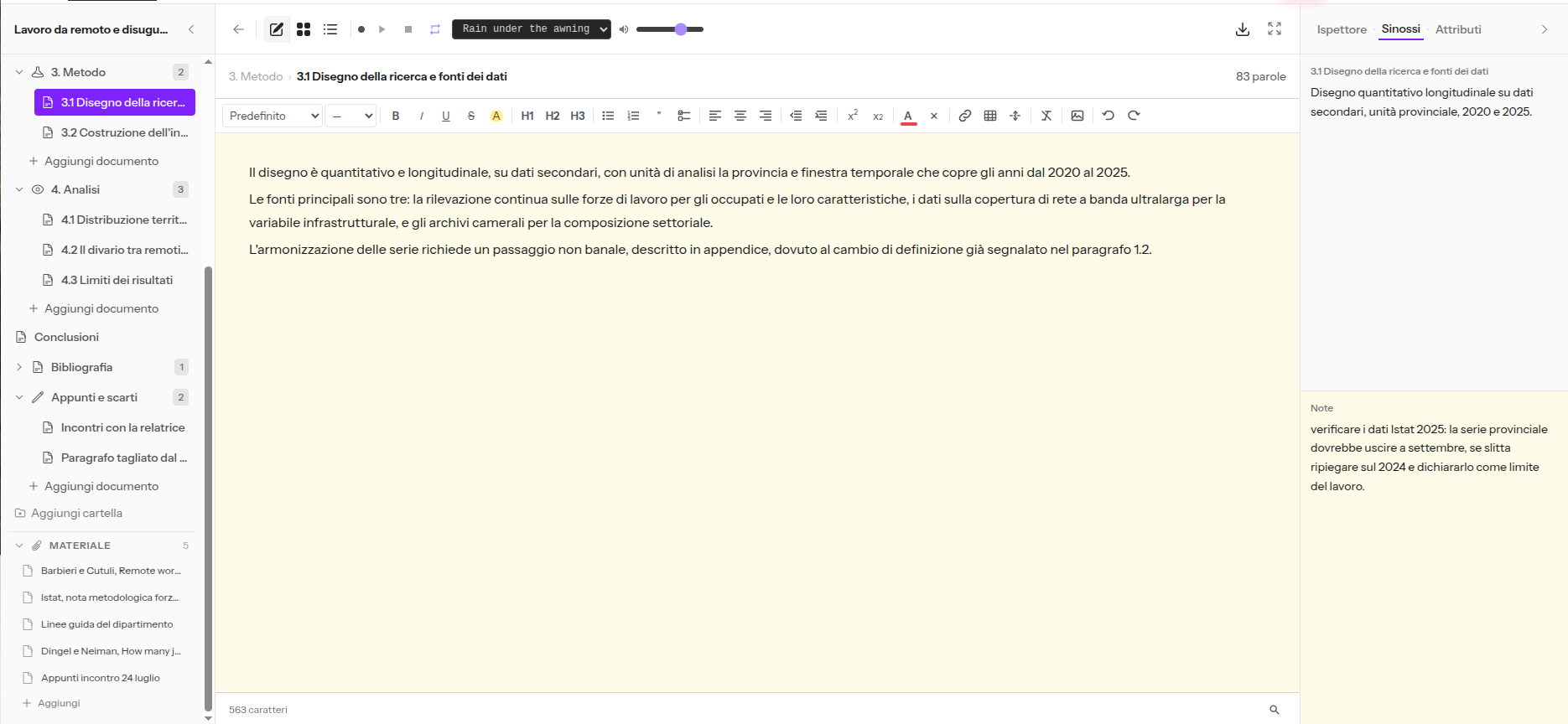
With a status on each chapter and a note on what's missing, exactly as you would with a long manuscript.
A dissertation gets written over months, with long interruptions made of exams, work and life. The real cost of each restart is the time spent reconstructing where you were.
The minimum scheme:
To write. It exists as an outline entry. The text doesn't.
Draft. Written, citations not yet tidied.
To revise. Written, and you already know what's wrong.
Revised. Critically reread, citations checked.
Sent to supervisor. With the date, so you know which version the comments refer to.
Add one line per chapter on what's outstanding: "check the 2025 ONS figures", "missing the comparison with the French case". It saves half an hour of rereading every time you come back.
What if it's a book rather than a dissertation?
Nearly everything holds, with three differences.
The question has to be interesting, not merely open. In a dissertation it's enough that the question is academically relevant. In a book for non specialists, someone has to want the answer.
The structure is yours. No prescribed title page, no compulsory chapters. The working outline rule still applies: every chapter proves something, or it isn't there.
The sources stay. They matter more, because a non specialist reader can't check for themselves. A popular non fiction book without references is a long opinion.
The same approach carries a monograph, a long technical report, a research paper. The common denominator never changes: many pages, many sources, many months, one argument you can't afford to lose sight of.
How you write a dissertation in GrinTale
An honest note first: GrinTale doesn't replace Word for final formatting. Your university's title page template, the prescribed margins, roman numerals on the front matter are word processor work, and they belong there.
GrinTale is for the phase that comes before, and lasts far longer: building and holding the work together. When the text is ready you export to DOCX and finish the layout where it needs finishing.
In practice:
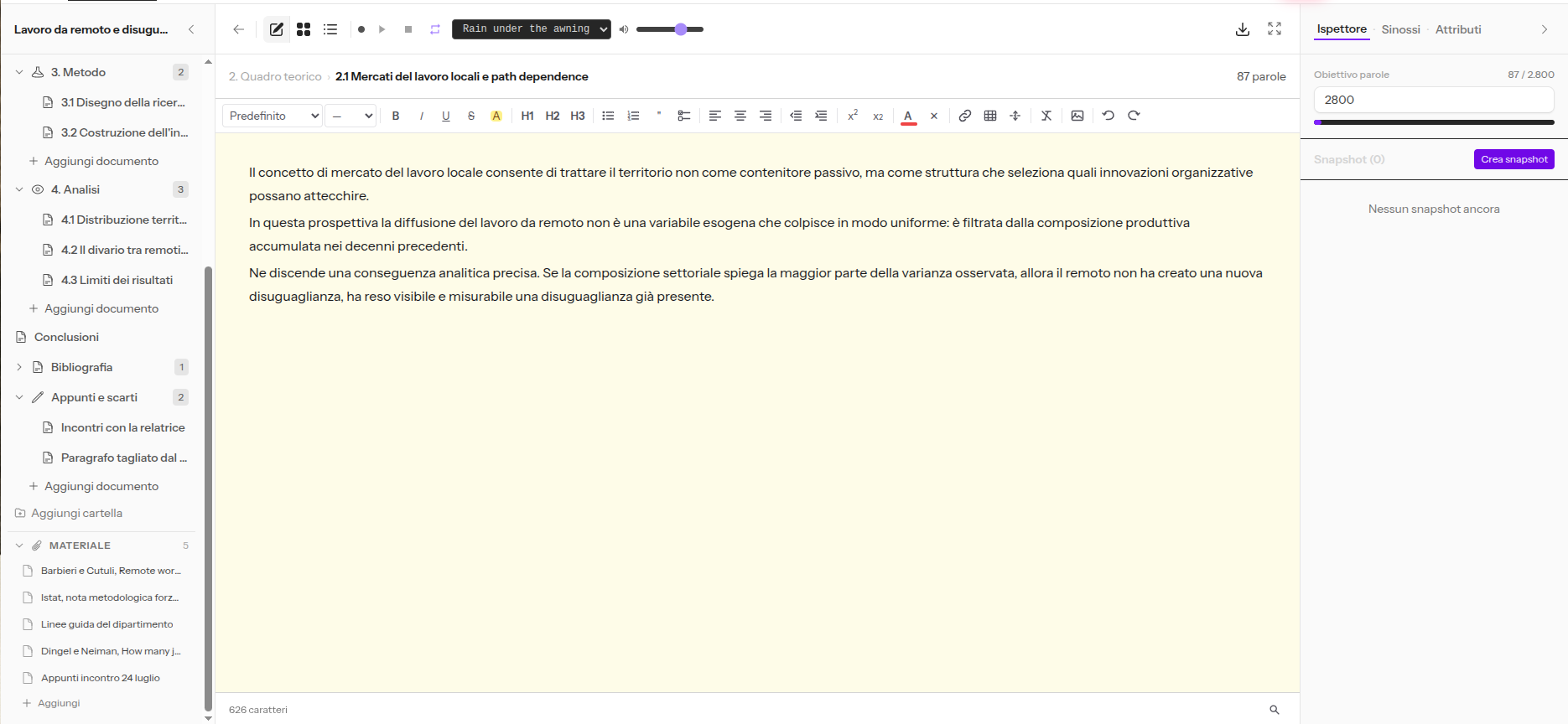
The Binder holds the work tree: one folder per chapter, one document per section, reorderable by dragging. Moving section 3.2 to the end of chapter 2 doesn't require renaming anything.
The Inspector keeps the synopsis, status and notes for each document. It's the working outline and the progress tracking described above, without a parallel spreadsheet.
The Corkboard shows every section side by side with synopsis and word count. It's the view where a disproportionate chapter becomes obvious.
The Material section holds article PDFs, images and data files inside the project, next to the text that uses them.
Snapshots save a picture of a chapter before a revision and let you go back. Useful above all before applying a supervisor's comments.
The GrinTale Encyclopedia and Dictionary open in a side panel inside the editor, for a quick check without leaving the text.
The per document word target with a progress bar works well on a long project, where daily progress is otherwise invisible.
If the dissertation is already started in Word, the import brings it in, detects the chapters and offers to split them into separate documents. We've discussed this here.
You can try it free for 15 days, no card required.
Try it now → https://grintale.it/register
In short
The formal structure of a dissertation takes ten minutes to find in your department handbook, and that's the easy part. What decides how the eight months go is different: a working outline where every entry declares what it proves, sources annotated the moment you read them rather than later, a writing order that starts from the analysis chapter and not the introduction, and a readable status on every piece so you don't restart from zero each time.
Four habits, not a complicated method. They cost little at the start and give back weeks at the end.
If you also write fiction, the approach is closer than it looks: see here. And if you're still choosing a medium, see here.
Frequently asked questions
How long should a dissertation be?
Undergraduate dissertations typically run 8,000 to 15,000 words and master's dissertations commonly 12,000 to 20,000 or more, but your department handbook overrides any general figure and your supervisor overrides the handbook. Ask at the first meeting.
Do you write the introduction first or the chapters?
The chapters. The introduction has to announce what the work actually does, and you only know that precisely at the end. Written first it gets rewritten anyway, so you may as well use it as the final pass.
How many chapters should a dissertation have?
Five is the common shape for empirical work: introduction, literature review, methodology, results and discussion, conclusion. Humanities dissertations often use thematic chapters instead. The number follows from the research question rather than being decided in advance.
How do I cite a source found online?
In your required citation style, with the URL and the access date. The date matters because pages change: without it, a note pointing at an edited page becomes unverifiable.
Can I write a dissertation in a single Word file?
You can, and under forty or fifty pages it works. Beyond that the problem isn't writing but navigating: moving a section, comparing two chapters, finding a passage all get slow in one document, and splitting it into separate files loses the overview.
Is the bibliography written at the end?
No, it's copied at the end. It should be built as you read, one entry per source, already in the correct style. Compiling it in the final week takes time exactly when you need it for rereading.
SOURCES
All sources retrieved and verified on 2026-08-18.
Scribbr UK, How long is a dissertation?, https://www.scribbr.co.uk/faqs/how-long-is-a-dissertation/
Pronto a scrivere il tuo prossimo capolavoro?
15 giorni gratis, nessuna carta richiesta.