How to Write Fear: Suspense Techniques from the Masters of Horror
If you're wondering how to write fear, the first answer is this: not with adjectives. "Terrifying", "bloodcurdling", "horrific" scare nobody. They tell readers what they should feel instead of making them feel it. Fear is built from what the reader knows and the character doesn't, from what stays out of sight, from one wrong detail in an ordinary room. And the masters of the genre explained it with surprising precision: Hitchcock with a bomb under a table, Poe by starting from the last page, Freud with a German word that won't translate.
This isn't a niche concern. In the first nine months of 2025, horror book sales in the US grew 7% over the same period a year earlier, according to Circana BookScan data reported by Publishers Weekly (Publishers Weekly, Booksellers Ride the Horror Wave). People who read horror want one thing: to be genuinely afraid. Here's how to write fear, one technique at a time.
In brief
Suspense comes from the reader knowing more than the character: Hitchcock explained it with a bomb hidden under a table.
Poe advised deciding the final effect before writing the first line, and keeping a story short enough to read in one sitting.
The uncanny, according to Freud (1919), is the familiar turned strange: an ordinary house with a single detail out of place.
The monster is scariest while it stays unseen: for Lovecraft, the strongest fear is fear of the unknown.
Stephen King names three levels, terror, horror and revulsion, and tells you to aim for the first.
What's the difference between suspense and surprise?
Surprise lasts a moment; suspense lasts the whole scene. Alfred Hitchcock explained it to François Truffaut in the long interview published as Hitchcock (1966, English edition 1967), with an example that became famous: two people are talking at a table, and under the table there's a bomb.
If the audience doesn't know about the bomb, the conversation is dull until everything explodes. A few seconds of surprise, and that's it. But if the audience saw someone plant the bomb and knows it will go off at one o'clock, every line of that same dull conversation becomes unbearable. Viewers want to shout at the characters to get up. Hitchcock put it in numbers: fifteen seconds of surprise against fifteen minutes of suspense.
In a novel the mechanism is identical. Give readers a piece of information the character doesn't have: the noise in the basement she didn't hear, the letter he hasn't opened yet, the car that's been parked outside the house for three days. Then let the character do ordinary things. The more everyday the scene, the more the tension builds, because the reader is waiting for one o'clock.
The practical consequence is counterintuitive: to frighten, you sometimes need to reveal earlier, not later. A sudden twist is worth a page. An announced danger can carry a whole chapter. If you want to control who knows what in a story, the decisive choice is point of view: that's where you decide what the reader knows and the character doesn't.
Why did Poe start from the ending?
Because fear is an effect, and an effect is designed backwards. In his essay The Philosophy of Composition, published in April 1846 in Graham's Magazine, Edgar Allan Poe wrote that "every plot, worth the name, must be elaborated to its dénouement before any thing be attempted with the pen" (Edgar Allan Poe Society of Baltimore).
His method started from a question: what impression do I want to leave? "I prefer commencing with the consideration of an effect," he wrote. Only then did he choose the events, the tone and the words that led to that effect, and he cut everything else. A successful horror story, by this logic, has no sentence that isn't working toward the final fear.
Poe added a rule about length. If a work is too long to be read at one sitting, it loses its unity of impression: between sittings, "the affairs of the world interfere, and every thing like totality is at once destroyed." It's one of the reasons the short story has been horror's natural form for two centuries.
For novelists the principle still holds, applied chapter by chapter. Before you write a frightening scene, ask what the reader should feel on its last line: unease, dread, the chill of a discovery. Then build backwards. An outline helps here: keeping the structure of your novel in view shows you where each blow lands and whether two scary scenes are competing with each other.
Why is the monster scarier when you can't see it?
Because the strongest fear is fear of the unknown, and the moment the monster appears it stops being unknown. H. P. Lovecraft opens his essay Supernatural Horror in Literature (1927) exactly there: "The oldest and strongest emotion of mankind is fear, and the oldest and strongest kind of fear is fear of the unknown" (H. P. Lovecraft Archive).
Readers fill the gaps with their own fears, which always work better than any description you could write. A claw described in detail is a claw. A scratch on the door, found in the morning, at the height of the handle, is something each reader pictures in their own way.
In practice, you have four tools for keeping the monster in the shadows:
Traces: footprints, objects moved, a smell, the dog's bowl empty and the dog gone. You show the effect, not the cause.
Senses other than sight: a sound upstairs, a floor colder in one spot, a door that pushes back. Sight gives certainty; the other senses don't.
The closed door: the character knows something is behind it but doesn't open it. The reader stays with them on the threshold.
Other people's reactions: a character who has seen it and can't describe it is scarier than any description.
When the monster finally shows itself, all the accumulated tension releases. That's why many of the most effective horror stories show it rarely, late, or never.
How do you make an ordinary scene unsettling?
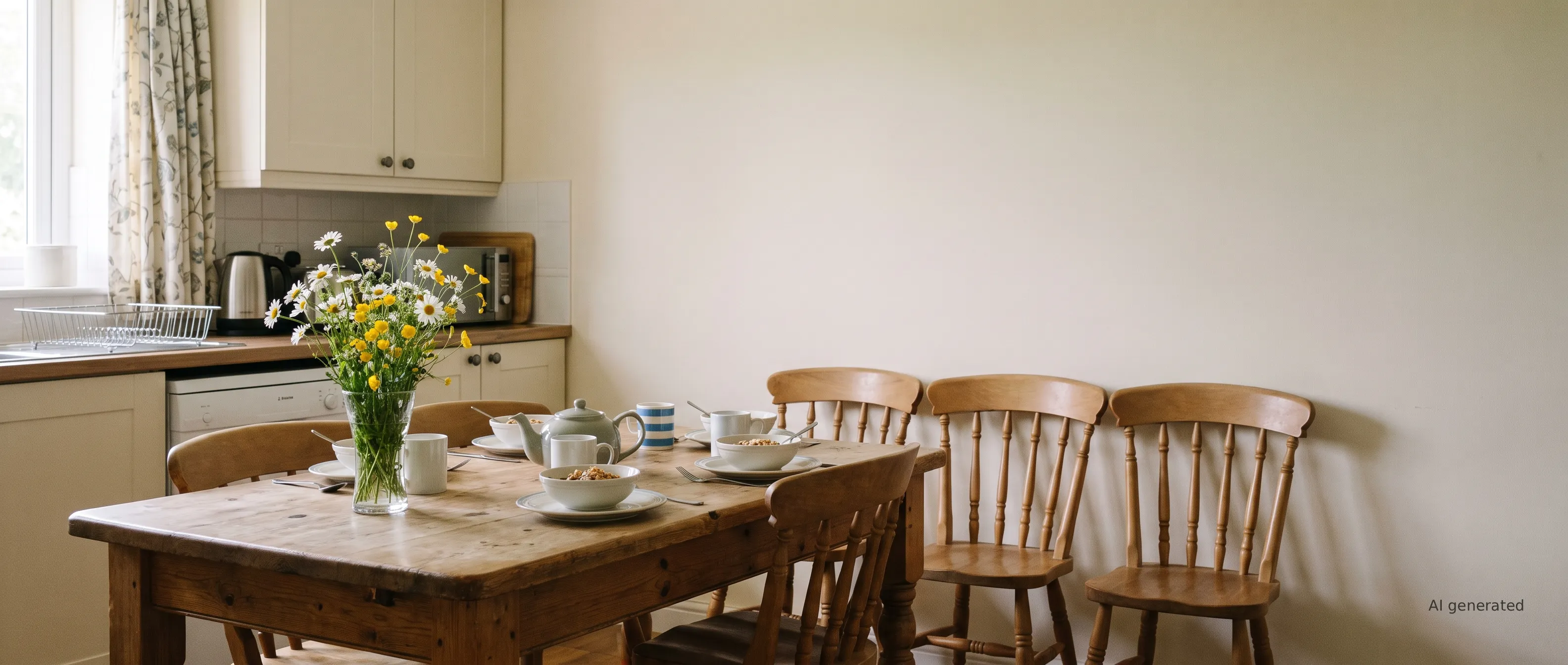
By moving a single element out of place. In his essay The Uncanny (Das Unheimliche, 1919), Sigmund Freud describes the uncanny as the class of the frightening that leads back to what is known of old and long familiar. What disturbs us most isn't the foreign: it's the familiar that suddenly turns strange.
Freud starts from the German word. Heimlich means homely, belonging to the house. Unheimlich, its opposite, is the uncanny: the home that stops being home. Fittingly, he builds the essay around a story, E. T. A. Hoffmann's The Sandman (1816), with its doll that seems alive.
For writers, it's the cheapest technique there is. You don't need creatures or castles. All it takes is:
a kitchen where every chair has been turned to face the wall;
a family photo with one person nobody recognizes;
a child who one morning calls their mother by her first name instead of "Mom";
a house left perfectly tidy, too tidy, after a burglar has been inside.
These examples share a rule: the misplaced detail only works if the rest of the scene is described with complete normality. The more ordinary and concrete the setting, the heavier the anomaly. If everything is already dark and menacing, the wrong detail gets lost in the noise. Unease comes from contrast, not from piling things on.
Why does "The Lottery" still frighten readers?
Because it has no monsters, only neighbors. Shirley Jackson's story appeared in The New Yorker in June 1948: in an ordinary town, on a fine summer day, the villagers gather for an annual ritual whose meaning the reader grasps only at the end.
The reaction was enormous. In "Biography of a Story" (1960), the talk in which she described that summer, Jackson recalled some three hundred letters, and only thirteen that spoke kindly to her (Library of America). Many readers wanted to know where the lottery really took place, and whether they could go and watch.
The lesson for writers is the uncanny taken to its extreme. Jackson tells everything with the calm of a news report: children gathering stones, men talking about tractors and taxes, women arriving late because they were finishing the dishes. No word announces the horror. It lies in the fact that nobody in the town sees it as horror.
This gives a piece of advice for every frightening scene: lower the narrator's voice exactly when the event is most terrible. Calm prose about an atrocious act hits harder than breathless prose. The reader feels the gap between tone and facts, and that gap is unsettling.
Terror, horror or revulsion: which should you aim for?
Terror, whenever you can. That's the hierarchy Stephen King sets out in Danse Macabre (1981), his book about horror in film, television and fiction. King names three levels of fear and ranks them.
Terror is the highest: the waiting, the sense that something is wrong, the thing you feel behind you and can't see. It's Lovecraft's territory and the uncanny's. Horror comes next: the moment the thing shows itself and you find out it's real. Revulsion is the lowest rung: the physical reaction, the blood, the disgust. King's advice is, in essence, to aim for terror, fall back on horror if terror won't come, and use revulsion as a last resort, admitting with a wink that he isn't proud.
The distinction helps you pick your tools. If a scene doesn't frighten, ask which level you're working at. Often the problem is that you skipped terror and went straight to horror, showing too much, too soon. Revulsion alone gets a grimace but doesn't linger: terror is what the reader takes to bed.
How do you build tension at sentence level?
With rhythm, before content. The same scene can be tense or flat depending on how the sentences are built, and readers feel it without noticing.
Four concrete tools:
Slow time down at the critical moment. When the character opens the door, don't write "she opened the door." Break the gesture down: the hand on the handle, the cold metal, the creak, the sliver of darkness. The closer the danger, the more narrative time stretches.
Shorten sentences as fear rises. Long sentences for the waiting, short ones for the alarm. Then shorter still. The reader's breathing follows the punctuation, and there's a guide on sentence rhythm and punctuation if you want to go further.
Limit what the character can perceive. Darkness, fog, a corridor with a single bulb. Every limit on perception is room for the reader's fear.
Cut the emotional adjectives. Instead of "a terrifying noise," write what the noise was and what the character did on hearing it. The reader decides it's terrifying, and that's why they believe it.
A useful exercise: take your frightening scene and circle every word that names an emotion (fear, terror, dread, horror, panic). Then rewrite each sentence, replacing the emotion with a physical fact or an action. The tremor in the voice, the hand that can't find the light switch, the counting of footsteps. Almost always, the version without emotional words is the scarier one.
Which mistakes kill the fear?
There are five common ones, and nearly all come from rushing toward the big moment:
Explaining too much. Readers don't need the detailed reason the house is haunted. Every rational explanation shrinks the unknown, and the unknown is your raw material.
Showing the monster too early. It's what King, in essence, calls skipping terror. Once seen, the monster becomes a problem to solve, not a fear.
Characters who behave absurdly. If readers think "why is she going down to the basement?", they stop being afraid with the character and start judging her. Give the character a strong reason to do the dangerous thing.
Constant tension with no pauses. Fear needs room to breathe. After a strong scene, give the reader a moment of calm: it makes the next one hit harder.
The repeated false alarm. The cat jumping out of the wardrobe works once. The second time, readers stop trusting the tension you build.
A good final test is the synopsis: if the fear vanishes completely when you summarize the story in a page, it probably relied on effects rather than structure.
Frequently asked questions
What's the difference between horror and thriller?
A thriller builds tension around a concrete, usually human danger, and hinges on the question "will they get out alive?". Horror works on fear itself, often with inexplicable or supernatural elements. Suspense techniques, starting with Hitchcock's bomb, work for both genres.
Does a horror story have to be short?
Not necessarily, but the short form helps. In 1846 Poe argued that a work readable in one sitting keeps its unity of effect better. Many of the most cited horror texts, from Poe to Shirley Jackson's "The Lottery", are short stories. In novels, the principle applies chapter by chapter.
How do you write fear without supernatural elements?
Often it's the most effective choice. Shirley Jackson's "The Lottery" has nothing supernatural in it, yet in 1948 it drew some three hundred letters from disturbed readers. The uncanny that Freud described comes from the familiar turning strange, not from ghosts.
How do you create suspense in a dialogue scene?
With Hitchcock's technique: give the reader information the characters who are talking don't have. Any conversation becomes tense once you know one of them is lying or that there's danger in the room. The more ordinary the dialogue, the more the tension builds.
In summary
Fear is written by controlling information, not with adjectives:
give the reader more information than the character, like Hitchcock's bomb;
decide the final effect before you write, like Poe;
keep the monster in the shadows, because the strongest fear is fear of the unknown;
put a single detail out of place in an ordinary scene;
tell the horror in a calm voice;
aim for terror before horror, and for revulsion only as a last resort.
Try rewriting a single scene with these rules. You'll probably find the scariest version is also the one where the least happens.
Sources
Publishers Weekly, Claire Kirch, Booksellers Ride the Horror Wave (October 10, 2025), retrieved 2026-10-17, https://www.publishersweekly.com/pw/print/20251013/98826-entrepreneurs-ride-the-wave-of-popularity-of-the-horror-genre.html
Edgar Allan Poe Society of Baltimore, Edgar Allan Poe, The Philosophy of Composition (Graham's Magazine, April 1846), retrieved 2026-10-17, https://www.eapoe.org/works/essays/philcomp.htm
H. P. Lovecraft Archive, H. P. Lovecraft, Supernatural Horror in Literature (1927), retrieved 2026-10-17, https://www.hplovecraft.com/writings/texts/essays/shil.aspx
Library of America, What "The Lottery" taught Shirley Jackson (December 14, 2010), retrieved 2026-10-17, https://blog.loa.org/2010/12/what-lottery-taught-shirley-jackson.html
François Truffaut, Hitchcock (1966; English edition 1967)
Sigmund Freud, Das Unheimliche (1919; English translation "The Uncanny")
Stephen King, Danse Macabre (1981)
Pronto a scrivere il tuo prossimo capolavoro?
15 giorni gratis, nessuna carta richiesta.